
Frusemide or Furosemide
Also known as: Furosemide
Furosemide is an antihypertensive agent. Furosemide is a prototype drug of Loop Diuretics. Loop diuretics have much greater diuretic effects than thiazides. Furosemide is a sulfonamide derivative. It has a carboxyl group with a sulfamoyl moiety in the meta position. A halide or phenoxy substitution is present at carbon 4, and a substituted amino group is present at carbon 2 or 3. Furosemide is characterized by high efficacy and rapid onset of action. It increases the urination and decrease the amount of water retained in the body.
Primary Characteristics
Frusemide or Furosemide is also known as Furosemide.
It belongs to Anthranilic Acid.
It belongs to Na-K-Cl triple cotransport inhibitor pharmacological group on the basis of mechanism of action and also classified in Diuretic Loop pharmacological group.
Molecular Weight: 330.7 · pKa: 3.8 · Solubility in Water: Insoluble · Solubility in Alcohol: 1 in 75 · Non-proprietary name: Frusemide or Furosemide.
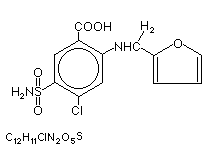
Pharmacokinetics
Absorption: Frusemide or Furosemide has an oral bioavailability is 64.5% (±2.5%).
Distribution: Frusemide or Furosemide has a volume of distribution is 170-270 ml/kg. plasma protein binding is 98.6%.
Elimination: it is metabolised via partly 35%, plasma half-life is 45 to 60 min, renal excretion is major 65%.
Advertisement
Indications
Frusemide or Furosemide is primarily indicated in conditions like Congestive heart failure, Degradation of pancreatic enzyme suppliments, Edema, Heart failure, Hypertension, Long-term treatment of healed reflux oesophagitis, Oedema, Oliguria, Oliguria due to renal failure, Oliguria due to renal failure, Oliguria due to renal failure, Oliguria due to renal failure, Oliguria due to renal failure, Oliguria due to renal failure, Oliguria due to renal failure, Oliguria due to renal failure, Pulmonary edema.
Frusemide or Furosemide is also indicated for secondary conditions like Bronchopulmonary dysplasia, Hemolytic-uremic syndrome, Hypercalcaemia, Raised intracranial pressure.
Contraindications
Frusemide or Furosemide is contraindicated in conditions like Anuria, Hepatic coma, Sulfone allergy, Hypersensitivity to the drug.
Dosage
Frusemide or Furosemide's dosage details are as follows:
| Dose | Single Dose | Frequency | Route | Instructions |
|---|---|---|---|---|
| Adult Dosage | ||||
| 20 – 80 mg | — | Every 24h | PO | |
| 40 mg | 40 mg | Every 24h | PO | Initially in Morning |
| Paediatric Dosage (20kg) | ||||
| 1 mg/kg | 1 mg/kg | Every 24h | Intra Muscular | - |
| 1 mg/kg | 1 mg/kg | Every 24h | Intra Venous | - |
| 1.5 mg/kg | 1.5 mg/kg | Every 8h | Oral | |
| Neonatal Dosage (3kg) | ||||
| 1 mg/kg | 1 mg/kg | Every 24h | Intra Muscular | - |
| 1 mg/kg | 1 mg/kg | Every 24h | Intra Venous | - |
| 1.5 mg/kg | 1.5 mg/kg | Every 8h | Oral | - |
Drug Interactions
Always consult your physician for the change of dose regimen or an alternative drug of choice that may strictly be required.
Side Effects
Frusemide or Furosemide in overdosage may give rise to further complications which include Photosensitivity , Skin rashes , Ototoxicity , Nephrocalcinosis , Hyponatremia , Urinary retention, Dizziness , Blurred vision , Hyponatremia, Urinary retention.
Frusemide or Furosemide produces potentially life-threatening effects which include Hypokalemia, Cardiac arrhythmias, Hypomagnesemia, CHO intolerance, Hyperosmolar non-ketotic precoma , Hypokalemia, Ototoxicity, Hypochloremic alkalosis, deafness, Hypocalcemic tetany, Life threatening hyponatremia. Careful monitoring is needed with proper medical management.
The signs and symptoms that are produced after acute overdosage of Frusemide or Furosemide are Postural hypotension, Decreased GFR , Decreased intravascular volume, Sodium & fluid depletion, Serious potassium loss in urine.
Frusemide or Furosemide is known to cause more or less tolerable side effects which are usually transient. These include Drowsiness, Dry mouth, Exfoliative dermatitis, Hypotension , Muscle cramps, Nausea, Restlessness, Skin rashes, thrist.
Warnings / Precautions
Interference in Pathology
Frusemide or Furosemide may interfere in the diagnosis of Falsely low values for urinary glucose by theClinistix and Diastix Methods .
Available Brands
Storage Conditions
Drug Classification
- 1.16.2 — Loop diuretics