
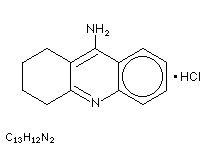
Tacrine (HCl)
A centrally acting reversible cholinesterase inhibitor, which is used to treat mild to moderate dementia of alzheimer's type. It improves cognitive (the operation of the mind by which we become aware of the objects of thoughts or perception) performance.
Primary Characteristics
It is of Synthetic origin.
Molecular Weight: 252.7 · pKa: 9.9 · Solubility in Water: highly · Solubility in Alcohol: highly · Non-proprietary name: Tacrine (HCl).
Pharmacokinetics
Absorption: Tacrine (HCl) has an oral bioavailability is 47.5% (±47.5%), pre-systemic (first-pass) metabolism accounts for 40% (±40%).
Distribution: Tacrine (HCl) has a volume of distribution is 350 litre. plasma protein binding is 55 %.
Elimination: plasma half-life is 2 - 3 hr, renal excretion is < 1 % unchanged.
Advertisement
Indications
Tacrine (HCl) is primarily indicated in conditions like Alzheimer's disease, Dementia, Respiratory depression.
Contraindications
Tacrine (HCl) is contraindicated in conditions like Anesthesia, Cardiovascular disease, GI diseases, Pulmonary disease, Hypersensitivity.
Dosage
Tacrine (HCl)'s dosage details are as follows:
| Dose | Single Dose | Frequency | Route | Instructions |
|---|---|---|---|---|
| Adult Dosage | ||||
| 10 mg | 10 mg | Every 6h | PO | For 6 weeks. |
| Paediatric Dosage (20kg) | ||||
| No data. | ||||
| Neonatal Dosage (3kg) | ||||
| No data. | ||||
Drug Interactions
Always consult your physician for the change of dose regimen or an alternative drug of choice that may strictly be required.
Side Effects
Tacrine (HCl) in overdosage may give rise to further complications which include Transaminase elevation.
The signs and symptoms that are produced after acute overdosage of Tacrine (HCl) are Muscular weakness, Increased salivation, Convulsions , Sweating , Vomiting, Nausea, Bradycardia, Hypotension.
Tacrine (HCl) is known to cause more or less tolerable side effects which are usually transient. These include Abdominal pain, Anorexia , Bradycardia , Change in BP, Constipation , Diarrhea, Dyspepsia , Flatulence, Nausea, Skin RashX, Vomiting .
Warnings / Precautions
Interference in Pathology
Tacrine (HCl) may interfere in the diagnosis of Liver Function Test (LFT) , Monitoring of liver enzymes.
Available Brands
None recorded.
Storage Conditions
Drug Classification
- 1.20 — Muscle relaxants and cholinesterase inhibitors