
Verapamil (HCl)
Also known as: Iproveratril HCl
Verapamil is an oral and parenteral calcium-channel blocking (CCB) agent. Verapamil (HCl) is useful for the treatment of angina, hypertension, and for supraventricular tachyarrhythmias. Verapamil is considered a class IV antiarrhythmic agent and Verapamil (HCl) is more effective than digoxin for controlling ventricular rate in patients with atrial fibrillation. Verapamil was synthesized in 1962 and, in 1981, became the first calcium channel blocker to be approved by the FDA. Verapamil inhibits the influx of extracellular calcium across the myocardial and vascular smooth muscle cell membranes. It exerts its activity at the membrane surface of arterial smooth muscle cells and within conductile and contractile tissue in the myocardium, but the serum calcium levels remain unchanged.
Primary Characteristics
Verapamil (HCl) is also known as Iproveratril HCl.
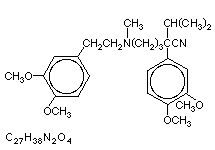
It is of Synthetic origin and belongs to Phenyl Valeronitrile.
It belongs to Calcium L-channel antagonist pharmacological group on the basis of mechanism of action and also classified in Anti arrhythmic agents pharmacological group.
Molecular Weight: 491.9 · Solubility in Water: 1 in 20 · Solubility in Alcohol: 1 in 25 · Non-proprietary name: Verapamil (HCl).
Pharmacokinetics
Absorption: Verapamil (HCl) has an oral bioavailability is 94% (±4%), pre-systemic (first-pass) metabolism accounts for 80%.
Distribution: Verapamil (HCl) has a volume of distribution is 4 - 7 l/kg. plasma protein binding is 90 %.
Elimination: it is metabolised via Hepatic, plasma half-life is 2-7 hr, renal excretion is <3%.
Advertisement
Indications
Verapamil (HCl) is primarily indicated in conditions like Angina, Cardiac arrhythmia, Hypertension, Ischaemic heart disease, Paroxysmal tachyarrhythmias, Supraventricular arrhythmias, Supraventricular tachycardia.
Verapamil (HCl) is also indicated for secondary conditions like Cardiomyopathy, Migraine, Psychosis, Pulmonary hypertension.
Contraindications
Verapamil (HCl) is contraindicated in conditions like Heart failure, Bradycardia, Platelet dysfunction.
Dosage
Verapamil (HCl)'s dosage details are as follows:
| Dose | Single Dose | Frequency | Route | Instructions |
|---|---|---|---|---|
| Adult Dosage | ||||
| 80 mg | 80 mg | Every 8h | PO | |
| Paediatric Dosage (20kg) | ||||
| 2.5 mg/kg | 2.5 mg/kg | Every 8h | Oral | - |
| Neonatal Dosage (3kg) | ||||
| 2.5 mg/kg | 2.5 mg/kg | Every 8h | Oral | |
Drug Interactions
Always consult your physician for the change of dose regimen or an alternative drug of choice that may strictly be required.
Side Effects
Verapamil (HCl) in overdosage may give rise to further complications which include Hepatotoxicity , Hyperprolactinemia, Impotence , Mental confusion , Myoclonic dystonia .
Verapamil (HCl) produces potentially life-threatening effects which include Cardiac arrhythmias, Heart failure. Careful monitoring is needed with proper medical management.
The signs and symptoms that are produced after acute overdosage of Verapamil (HCl) are Bradycardia, Hypotension, AV block.
Verapamil (HCl) is known to cause more or less tolerable side effects which are usually transient. These include Constipation , Dizziness, Fatigue, Flushing, Headache, Nausea, Palpitation.
Warnings / Precautions
Available Brands
Storage Conditions
Drug Classification
- 1.12.1 — Antianginal drugs
- 2.12.2 — Antiarrhythmic drugs
- 3.12.3.2 — Calcium antagonists