
Ramipril
Ramipril is oral angiotensin-converting enzyme (ACE) inhibitor used in the treatment of hypertension, heart failure. Ramipril is actually an inactive prodrug that is converted in the liver to itat, the active moiety, whose antihypertensive activity is sufficiently long to allow for once-daily administration. The pharmacodynamic characteristics of it most closely resemble those of benazepril, fosinopril, and quinapril, all of which are prodrugs. The active metabolite, itat, competes with angiotensin-converting enzyme for the substrate angiotensin I, blocking its conversion to angiotensin II, which is a potent vasoconstrictor and negative-feedback mediator for renin activity. Lower levels of angiotensin II produce a drop in blood pressure and a rise in plasma renin. It also inhibits Kininase II (identical to ACE), an enzyme that degrades bradykinin, a potent vasodilator, to inactive peptides, resulting in increased bradykinin levels. Bradykinin-induced vasodilation is thought to be of secondary importance in the blood-pressure lowering effect. A bradykinin mechanism may, however, contribute to ACE-inhibitor-induced angioneurotic edema.
Primary Characteristics
It is of Synthetic origin and belongs to Phenylproplycarboxy acid.
It belongs to Angiotensin converting enzyme inhibitor-ACEI pharmacological group on the basis of mechanism of action and also classified in Antihypertensive Agents pharmacological group.
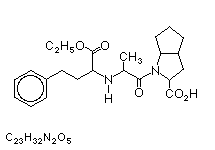
Molecular Weight: 416.5 · pKa: 3.1, 5.6 · Solubility in Water: low · Solubility in Alcohol: soluble · Non-proprietary name: Ramipril.
Pharmacokinetics
Absorption: Ramipril has an oral bioavailability is 60%.
Distribution: Ramipril has a volume of distribution is 91.5 litre. plasma protein binding is 65 - 80 %.
Elimination: it is metabolised via Hepatic, plasma half-life is 0.3 - 1 hr, renal excretion is 86 %.
Advertisement
Indications
Ramipril is primarily indicated in conditions like Benign gastric ulcer associated with H.pylori, Congestive heart failure (adjunct), Gastric acid reduction during anaesthesia, Heart failure, Hypertension, Iron deficiency anaemia, Mild to moderate hypertension, Prophylaxis of cardiovascular events/stroke.
Contraindications
Ramipril is contraindicated in conditions like Salt depletion, Hypotension, Arterial stenosis.
Dosage
Ramipril's dosage details are as follows:
| Dose | Single Dose | Frequency | Route | Instructions |
|---|---|---|---|---|
| Adult Dosage | ||||
| 2.5 mg | 2.5 mg | Every 24h | PO | Initially in 1-2 div.doses. |
| 3.75 mg | 3.75 mg | Every 24h | PO | Maintenance |
| Paediatric Dosage (20kg) | ||||
| 0 – 0 | — | — | Not recommended in this age group | |
| Neonatal Dosage (3kg) | ||||
| 0 – 0 | — | — | Not recommended in this age group | |
Drug Interactions
Always consult your physician for the change of dose regimen or an alternative drug of choice that may strictly be required.
Side Effects
Ramipril in overdosage may give rise to further complications which include Angioedema .
Ramipril produces potentially life-threatening effects which include Hypotension, Renal failure. Careful monitoring is needed with proper medical management.
The signs and symptoms that are produced after acute overdosage of Ramipril are Hypotension, Renal insufficiency.
Ramipril is known to cause more or less tolerable side effects which are usually transient. These include Diarrhea, Dizziness, Headache, Nausea and vomiting, Rashes .
Warnings / Precautions
Interference in Pathology
Ramipril may interfere in the diagnosis of Tests for Renin Concentrations .
Available Brands
Storage Conditions
Drug Classification
- 1.12.3.3 — ACE inhibitors