
Polymyxin B (Sulphate)
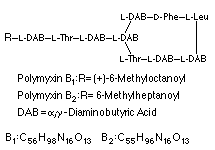
Polymyxin B (Sulphate) is antibiotic derived from a strain of Bacillus polymyxa. Polymyxin B (Sulphate) is a sulfate salt of the least toxic member of the polymixin group. Polymyxin B (Sulphate) is bacteriocidal for many gram negative bacteria. Polymyxin B (Sulphate) is a cationic, basic peptide contains fatty acid D-6-methyloctan-1-oic acid and amino acids L-threonine and L-diaminobutyric acid. Polymyxin B (Sulphate) is used in the treatment of various systemic, urinary tract, otic, ophthalmic and cutaneous infections due to susceptible gram -ve bacteria. Polymyxin B (Sulphate) is administered orally, parentrally and topically, but nowadays, rarely used parentrally due to its potential for causing nephrotoxicity and/or neurotoxicity. Polymyxin B (Sulphate) is more commonly administered as either a topical or otic agent in combination with neomycin or bacitracin. Polymyxin B (Sulphate) is also available in ophthalmic solutions in combination with either trimethoprim B or in combination with bacitracin and neomycin. Polymyxin B is also used in combination with neomycin as a urinary tract irrigant. Polymyxin B was originally approved by the FDA in 1951.
Primary Characteristics
It is of Semi Synthetic origin and belongs to Decapeptide.
It belongs to Antibiotic (Cell Wall) pharmacological group on the basis of mechanism of action and also classified in Antibiotics pharmacological group.
Molecular Weight: 1203 · pKa: 8.9 · Solubility in Water: high · Solubility in Alcohol: slightly soluble · Non-proprietary name: Polymyxin B (Sulphate).
Pharmacokinetics
Absorption: Polymyxin B (Sulphate) has an oral bioavailability is 0.5% (±0.5%).
Distribution: Polymyxin B (Sulphate) has a plasma protein binding is 50%.
Elimination: plasma half-life is 4-6 hr, renal excretion is 60%.
Advertisement
Indications
Polymyxin B (Sulphate) is primarily indicated in conditions like Bacteremia, Meningitis, Superficial infections, Urinary tract infection.
Polymyxin B (Sulphate) is also indicated for secondary conditions like Joint infections, Skin infections.
Contraindications
Polymyxin B (Sulphate) is contraindicated in conditions like Hypersensitivity to the drug.
Dosage
Polymyxin B (Sulphate)'s dosage details are as follows:
| Dose | Single Dose | Frequency | Route | Instructions |
|---|---|---|---|---|
| Adult Dosage | ||||
| 22500 units/kg/day | 22500 units/kg/day | Every 24h | IM | This should be reduced in the presence of renal impairment.The dosage may be divided and given at either 4 or 6 hour intervals. |
| 20000 units/kg/body weight/day | 20000 units/kg/body weight/day | Every 24h | IV | Infusions may be given every 12 hours, however, the total daily dose must not exceed 25,000 units/kg/day. |
| 7.5 ml | 7.5 ml | Every 6h | Ophthalmic | Frequency may be increased upto 6 times/day. |
| 10000 units/g | 10000 units/g | Every 12h | Ophthalmic,Otic | Ointment |
| 1 stripe | 1 stripe | Every 12h | Topical | Apply Ointment on effacted area. |
| Paediatric Dosage (20kg) | ||||
| 0.33 mg/kg | 0.33 mg/kg | Every 24h | Intrathecal | For above 2 yrs children |
| Neonatal Dosage (3kg) | ||||
| 0.25 mg/kg | 0.25 mg/kg | Every 24h | Intrathecal | |
Drug Interactions
Always consult your physician for the change of dose regimen or an alternative drug of choice that may strictly be required.
Side Effects
Polymyxin B (Sulphate) in overdosage may give rise to further complications which include Psychosis , Coma , Hypersensitivity reactions , Neuromuscular blockage , Convulsions .
Polymyxin B (Sulphate) produces potentially life-threatening effects which include Nephrotoxicity, Neurotoxicity , Hematuria, Respiratory paralysis. Careful monitoring is needed with proper medical management.
Polymyxin B (Sulphate) is known to cause more or less tolerable side effects which are usually transient. These include Ataxia, Azotemia, Blurred vision, Confusion, Dizziness, Drowsiness, Flushing, Muscle weakness, Nausea, Paresthesias, Proteinuria , Reaction at injection site, Urticaria, Vomiting .
Warnings / Precautions
Available Brands
Click on a strength to view available brands.
Single Ingredient
Multi-Ingredient Combinations
Storage Conditions
Drug Classification
- 1.6.2.2.10 — Polymyxins
- 2.13.2.1 — Antibacterials, topical
- 3.21.1.1 — Antibacterials
- 4.28 — Otic drugs