
Phenobarbitone
Also known as: Ethophenylbarbituric Acid, Phenobarbital
Phenobarbitone is oral and parenteral barbiturate with anticonvulsant and sedative-hypnotic properties. Phenobarbital is the oldest of the commonly used anticonvulsants. Phenobarbitone is also the longest-acting agent in the barbiturate group. In general, Phenobarbitone is effective in all seizure disorders except absence (petit mal). It was regularly prescribed to prevent febrile seizures, but now it is infrequently used for this due to side effects and lack of efficacy. It was first used as an anticonvulsant in 1912, and it was approved by the FDA in 1939. Anticonvulsant action of phenobarbitaone is a combined result of elevating the seizure threshold and inhibiting the spread of discharges from a seizure focus. It inhibits the spread of seizure activity in the cortex, thalamus, and limbic systems, and increases the threshold for electrical stimulation of the motor cortex. There is a decrease in both pre- and postsynaptic excitability.
Primary Characteristics
Phenobarbitone is also known as Ethophenylbarbituric Acid, Phenobarbital.
It is of Synthetic origin and belongs to Barbiturate.
It belongs to Chloride Channel opener (Gaba operated) pharmacological group on the basis of mechanism of action.
Molecular Weight: 232.2 · pKa: 7.2 · Solubility in Water: 1 in 1000 · Solubility in Alcohol: 1 in 10 · Non-proprietary name: Phenobarbitone · pH: 9.2 · Isotonic value: 3.95.
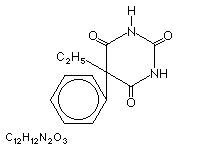
Pharmacokinetics
Absorption: Phenobarbitone has an oral bioavailability is 92.5% (±2.5%).
Distribution: Phenobarbitone has a volume of distribution is 0.7 l/kg. plasma protein binding is 50 %.
Elimination: it is metabolised via Hepatic, plasma half-life is 50 - 150 hr, renal excretion is 25 - 67 %.
Advertisement
Indications
Phenobarbitone is primarily indicated in conditions like Benign febrile convulsions of infancy, Epilepsy, Seizures, Short-term treatment of severe congestive heart failure, Status epilepticus.
Contraindications
Phenobarbitone is contraindicated in conditions like Porphyrias, Hepatic disease.
Dosage
Phenobarbitone's dosage details are as follows:
| Dose | Single Dose | Frequency | Route | Instructions |
|---|---|---|---|---|
| Adult Dosage | ||||
| 125 mg | 125 mg | Every 6h | IV,IM | |
| 120 mg | 120 mg | Every 24h | PO | Taken at night. |
| Paediatric Dosage (20kg) | ||||
| 3.1 mg/kg | 3.1 mg/kg | Every 24h | Oral | - |
| Neonatal Dosage (3kg) | ||||
| 3.1 mg/kg | 3.1 mg/kg | Every 24h | Oral | - |
Drug Interactions
Always consult your physician for the change of dose regimen or an alternative drug of choice that may strictly be required.
Side Effects
Phenobarbitone in overdosage may give rise to further complications which include Aggression, Ataxia , Confusion , Irritability , Mental disturbances , Nystagmus .
Phenobarbitone produces potentially life-threatening effects which include Agranulocytosis, Aplastic Anemia , Exfoliative dermatitis, Hepatitis . Careful monitoring is needed with proper medical management.
The signs and symptoms that are produced after acute overdosage of Phenobarbitone are Coma and death, Sedation , Stupor .
Phenobarbitone is known to cause more or less tolerable side effects which are usually transient. These include Erythema, Morbiliform, Skin rashes.
Warnings / Precautions
Available Brands
Storage Conditions
Drug Classification
- 1.5 — Anticonvulsants and Antiepileptics
- 2.24.3 — Drugs used in anxiety and sleep disorders