
Neostigmine
Also known as: Neost gmine
Neostigmine (Methylsulphate) is a potent reversible inhibitor of acetylcholinesterase and its use is inthe treatment of mysthania gravis. Neostigmine bromide and neostigmine methylsulphate are quaternary ammonium compound. The pharmacologic properties of neostigmine mimic those of acetylcholine. Neostigmine (Methylsulphate) is more polar and does not enter in the CNS. its effects on skeletal muscle is greater than that of physostigmine.Neostigmine bromide and neostigmine methylsulphate are available for oral, opthalmic and parentral administration.
Primary Characteristics
Neostigmine is also known as Neost gmine, Neostigmine (Methylsulphate), Neostigmine Bromide.
It is of Synthetic origin and belongs to Quaternary Ammonium.
It belongs to Cholinestrase inhibitor pharmacological group on the basis of mechanism of action and also classified in Cholinergic Agonist pharmacological group. It is also classified under Antidotes .
Molecular Weight: 223.3 · pKa: 12.0 · Solubility in Water: 1 in 0.5 · Solubility in Alcohol: 1 in 6 · Non-proprietary name: Neostigmine · pH: 4.6 · Isotonic value: 4.98.
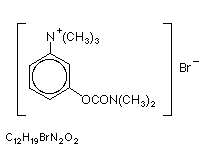
Pharmacokinetics
Absorption: Neostigmine has an oral bioavailability is 35% (±5%).
Distribution: Neostigmine has a volume of distribution is 0.6-1.04 l/kg. plasma protein binding is 15-25%.
Elimination: it is metabolised via in plasma, plasma half-life is ~ 0.38-1 hr, renal excretion is 20%.
Advertisement
Indications
Neostigmine is primarily indicated in conditions like Adynamic ileus, Myasthenia gravis, Myasthenia gravis diagnosis, Neuromuscular blockade reversal, Reversal of non-depolarizing neuromuscular blockade.
Neostigmine is also indicated for secondary conditions like Paralytic ileus, Urinary retention, Urinary retention.
Contraindications
Neostigmine is contraindicated in conditions like Intestinal obstruction, Urinary obstruction.
Dosage
Neostigmine's dosage details are as follows:
| Dose | Single Dose | Frequency | Route | Instructions |
|---|---|---|---|---|
| Adult Dosage | ||||
| 0.02 mg/ kg | 0.02 mg/ kg | — | IM | For diagnosis of myasthenia gravis |
| 1.5 mg | 1.5 mg | — | IV, IM, SC | Additional doses depend upon the patient response. Max. 10mg/day |
| 187.5 mg | 187.5 mg | Every 4h | PO | Max. 180mg/day |
| 500 ug | 500 ug | Every 4h | PO,S/C,IM | For paralytic ileus & postperative urinary retention. |
| Paediatric Dosage (20kg) | ||||
| 80 ug/kg | 80 ug/kg | — | Intra Venous | To severe neuromuscular blockade. |
| 500 mg/kg | 500 mg/kg | Every 6h | Oral | For Myasthenia grains. |
| Neonatal Dosage (3kg) | ||||
| 50 ug/kg | 50 ug/kg | — | Intravenous | As required |
| 0.75 mg/kg | 0.75 mg/kg | Every 6h | Oral | For all ages |
Drug Interactions
Always consult your physician for the change of dose regimen or an alternative drug of choice that may strictly be required.
Side Effects
Neostigmine in overdosage may give rise to further complications which include Hallucinations , Hallucinations , Anxiety , Epilepsy , Disorientation , Loss of consciousness.
Neostigmine produces potentially life-threatening effects which include Cholinergic crises, Depolarizing block. Careful monitoring is needed with proper medical management.
The signs and symptoms that are produced after acute overdosage of Neostigmine are Bradycardia, Hypotension, Nausea, Vomiting, Diarrhea, Convulsions , Increased bronchial secretion, Ataxia, Sweating , Miosis, Abdominal cramps, Increased peristalsis, Sweating, Fasciculation of skeletal muscles, General weakness, Increased bronchial secretion, Mucular cramps, Salivation .
Neostigmine is known to cause more or less tolerable side effects which are usually transient. These include Abdominal pain, Diarrhea, Nausea, Salivation , Sweating , Vomiting .
Warnings / Precautions
Interference in Pathology
Neostigmine may interfere in the diagnosis of None well documented.
Available Brands
Storage Conditions
Drug Classification
- 1.1.4 — Muscle relaxants and cholinesterase inhibitors
- 2.20 — Muscle relaxants and cholinesterase inhibitors