
Amikacin (Sulphate)
The antimicrobial agents or antibiotics develops during the last 60 years are among the most dramatic examples of the advances of science. The remarkably powerful and specific activity of antimicrobial drug is due to the their selectivity for highly specific targets that are either unique to micro-organism or much more important in them than in humans. Amikacin is a semi-synthetic derivative of kanamycin. It belongs to aminoglycoside antibiotic and Amikacin (Sulphate) is less toxic than parent drug, kanamycin. The aminoglycosides are the compound containing characteristic amino sugars joined to a hexose nucleus in glycoside linkage and their polarity accounts for their pharmakokinetic peoperties. Antibiotics require constant drug level in body for therapeutic effect. This is achieve by taking the medication at regular intervel of time throughout the day and night as prescribed. Amikacin (Sulphate) is important to take the drug for the full time period as prescribed. If you discontinue the therapy, it may result in ineffective treatment.
Primary Characteristics
It is of Semi Synthetic origin and belongs to Glucopyranosyl streptamine.
It belongs to Antibacterial (Proetin synthesis inhibitor) pharmacological group on the basis of mechanism of action.
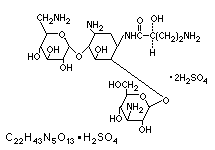
Molecular Weight: 781.8 · pKa: 8.1 · Solubility in Water: moderate · Solubility in Alcohol: negligible · Non-proprietary name: Amikacin (Sulphate) · pH: 2.
Pharmacokinetics
Absorption: Amikacin (Sulphate) has an oral bioavailability is 0.5% (±0.5%).
Distribution: Amikacin (Sulphate) has a volume of distribution is 0.2-0.25 l/kg. plasma protein binding is < 10%.
Elimination: plasma half-life is 2.2-2.5 hr, renal excretion is 100-800 mg/l.
Advertisement
Indications
Amikacin (Sulphate) is primarily indicated in conditions like Burns, Cholangitis, Endometritis, Heart failure, Infectons in neutropenic patients, Meningitis, Mycobacterial infection, Neonatal infections, Peritonitis, Respiratory tract infections, Supraventricular arrhythmias (particularly atrial fibrillation), Urinary tract infection.
Contraindications
None recorded.
Dosage
Amikacin (Sulphate)'s dosage details are as follows:
| Dose | Single Dose | Frequency | Route | Instructions |
|---|---|---|---|---|
| Adult Dosage | ||||
| 15 mg/kg | 15 mg/kg | Every 12h | IV,IM | Initial maximum dose: 1.5 g/24hr. After initial maximum dose monitor the level. |
| Paediatric Dosage (20kg) | ||||
| 7.5 mg/kg | 7.5 mg/kg | Every 12h | Intra Venous | - |
| Neonatal Dosage (3kg) | ||||
| 7.5 mg/kg | 7.5 mg/kg | Every 8h | Intramuscular | |
| 7.5 mg/kg | 7.5 mg/kg | Every 8h | Intravenous | |
Drug Interactions
Always consult your physician for the change of dose regimen or an alternative drug of choice that may strictly be required.
Side Effects
Amikacin (Sulphate) in overdosage may give rise to further complications which include Neuromuscular blockage , Nephrotoxicity , Renal tubular acidosis.
The signs and symptoms that are produced after acute overdosage of Amikacin (Sulphate) are 8th nerve damage.
Amikacin (Sulphate) is known to cause more or less tolerable side effects which are usually transient. These include Ataxia, Azotemia, Circumoral paresthesia, Ototoxicity , Proteinuria , Pyuria, Sense of fulness in ears, Tinnitus, Vertigo.
Warnings / Precautions
Available Brands
Storage Conditions
Drug Classification
- 1.6.2.2.5 — Aminoglycosides
- 2.6.2.4 — Anti-tuberculosis drugs