
Mannitol
Also known as: Manna sugar, Cordycepic Acid
Mannitol most extensively employed as osmotic diuretic. its D-enantiomer is used clinically.it opposes reabsorption of water which normally accompanies sodium reabsorption from kidney tubule. Used when there is a danger renal failure (e.g shock, cardiovascular surgery) and in fluid overload refactory to other diuretics. May cause cardiac failure owing to increase circulating blood volume. Mannitoladministered by intravenous infusion.
Primary Characteristics
Mannitol is also known as Manna sugar, Cordycepic Acid.
It is of Synthetic origin and belongs to Sugar Alcohol.
Molecular Weight: 182.2 · Solubility in Water: Freely soluble · Solubility in Alcohol: Soluble · Non-proprietary name: Mannitol · pH: 6.2 · Isotonic value: 5.07.
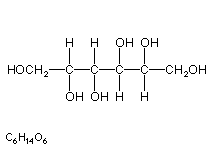
Pharmacokinetics
Distribution: Mannitol has a volume of distribution is 0.16-0.27 l/kg.
Elimination: it is metabolised via Hepatic, plasma half-life is 2-36 hr, renal excretion is 80%.
Advertisement
Indications
Mannitol is primarily indicated in conditions like Bladder irrigation, Cerebral oedema, Diuresis, Edematous states, Oliguria, Poisoning, Raised intracranial pressure, Raised iop, Renal insufficiency, Reperfusion injury, Sodium depletion, Termination of pregnancy.
Contraindications
Mannitol is contraindicated in conditions like Acidosis, Congestive heart failure, Pulmonary edema, Intracranial hemorrhage, Dehydration, Inadequate urine flow.
Dosage
Mannitol's dosage details are as follows:
| Dose | Single Dose | Frequency | Route | Instructions |
|---|---|---|---|---|
| Adult Dosage | ||||
| 50 – 100 g | — | Every 24h | IV Inf | Initial dose |
| 15 – 25 % | — | Every 24h | IV Inf | |
| 0.2 g/ kg/dose | 0.2 g/ kg/dose | — | IV Inf | Test Dose, Max. 12.5gm over 3-5 min, If there is no diuresis within 2 hrs. discontinue mannitol |
| 0.375 g/ kg | 0.375 g/ kg | Every 6h | IV Inf | Maintenance dose |
| Paediatric Dosage (20kg) | ||||
| 2 g/ug | 2 g/ug | — | ||
| 41.66 mg/kg.min | 41.66 mg/kg.min | — | IV Infusion | Once for 30 Minutes .Can be repeated |
| Neonatal Dosage (3kg) | ||||
| 41.46 mg/kg.min | 41.46 mg/kg.min | — | IV Infusion | Infuse over 30 min.Repeat the dose as required |
Drug Interactions
Always consult your physician for the change of dose regimen or an alternative drug of choice that may strictly be required.
Side Effects
Mannitol in overdosage may give rise to further complications which include Dehydration , Hyponatremia , Oedema , Skin necrosis , Hyponatremia, Inflammation.
Mannitol produces potentially life-threatening effects which include Pulmonary edema , Convulsions , Hypertension, Hypotension, Anaphylaxis , Fluid & electrolyte imbalance, Water intoxication. Careful monitoring is needed with proper medical management.
The signs and symptoms that are produced after acute overdosage of Mannitol are Coma, Confusion , Lethargy, Stupor , Severe hyponatremia.
Mannitol is known to cause more or less tolerable side effects which are usually transient. These include Blurred vision, Chest pain, Chills, Dizziness, Fever, Headache, Hypokalemia , Nausea, Tachycardia, Thirst, Thrombophlebitis , Urinary retention, Urinary RetentionX, Vomiting , Xerostomia .
Warnings / Precautions
Interference in Pathology
Mannitol may interfere in the diagnosis of False +ve estimation of Ethylene Glycol , Some methods of Serum Inorganic Phosphates .
Available Brands
Storage Conditions
Drug Classification
- 1.16.4 — Osmotic diuretics
- 2.26.2.5 — Osmotic therapy solutions