
Isosorbide (Dinitrate)
Also known as: Sorbide Nitrate, ISDN
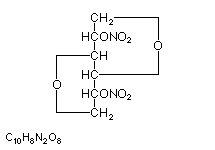
Isosorbide (DinIitrate) is a vasodiIator used for symptomatic or prophylactic treatmentof angina pectoris and resistant heart failure. Administered as sublingually or orally.Chemically Isosorbide (Dinitrate) is identified as 1, 4:3, 6-dianhydro-D-glucitol dinitrate, the dinitric acid ester of isosorbide, which is a bicyclic ether derivative of glucitol. Isosorbide (Dinitrate) is prepared by chemical synthesis from sorbitol.
Primary Characteristics
Isosorbide (Dinitrate) is also known as Sorbide Nitrate, ISDN.
It is of Synthetic origin and belongs to Nitrates.
It belongs to EDRF (NO) agonist pharmacological group on the basis of mechanism of action and also classified in Vasodilators pharmacological group. It is also classified under Antianginal Agents .
Molecular Weight: 236.1 · Solubility in Water: very slightly soluble · Solubility in Alcohol: Sparingly soluble · Non-proprietary name: Isosorbide (Dinitrate).
Pharmacokinetics
Absorption: Isosorbide (Dinitrate) has an oral bioavailability is 94% (±4%), pre-systemic (first-pass) metabolism accounts for 40% (±40%).
Distribution: Isosorbide (Dinitrate) has a volume of distribution is 100-600 litre. plasma protein binding is ~30%.
Elimination: it is metabolised via Hepatic, plasma half-life is 40-60 min, renal excretion is <1%.
Advertisement
Indications
Isosorbide (Dinitrate) is primarily indicated in conditions like Angina, Chronic heart failure, Fluid and electrolyte loss in diarrhoea, Left ventricular failure, Long-term treatment of healed reflux oesophagitis, Moderate to severe reflux oesophagitis, Prinzmetal's angina, Prophylaxis and treatment of angina, Prophylaxis of angina, Prophylaxis of stress ulceration, Treatment of angina, Treatment of angina and left ventricular failure, Unstable angina.
Isosorbide (Dinitrate) is also indicated for secondary conditions like Congestive heart failure.
Contraindications
Isosorbide (Dinitrate) is contraindicated in conditions like Hypovolaemia, Myocardial infarction, Cardiac temponade, Raised intracranial pressure, Low cardiac output, Obstructive hypertrophic cardiomyopathy.
Dosage
Isosorbide (Dinitrate)'s dosage details are as follows:
| Dose | Single Dose | Frequency | Route | Instructions |
|---|---|---|---|---|
| Adult Dosage | ||||
| 7.5 mg | 7.5 mg | — | Lingually | Every 2 to 3 hours |
| 95 mg | 95 mg | Every 12h | PO | up to 240 mg |
| 120 mg | 120 mg | Every 12h | PO,Oral | |
| 6.25 mg | 6.25 mg | — | Sublingual | For angina. |
| Paediatric Dosage (20kg) | ||||
| 20 kg | 20 kg | — | ||
| Neonatal Dosage (3kg) | ||||
| No data. | ||||
Drug Interactions
Always consult your physician for the change of dose regimen or an alternative drug of choice that may strictly be required.
Side Effects
Isosorbide (Dinitrate) in overdosage may give rise to further complications which include Hypotension , Restlessness , Hypotension , Syncope , Collapse , Decreased cardiac output , Paradoxical bradycardia , Pallor.
The signs and symptoms that are produced after acute overdosage of Isosorbide (Dinitrate) are Hypotension, Flushing, Tachycardia , Confusion , Palpitations , Headache, Syncope , Neurologic deficit, Increased intracranial pressure.
Isosorbide (Dinitrate) is known to cause more or less tolerable side effects which are usually transient. These include Fecal incontinence, Headache, Nausea, Orthostatic hypotension, Palpitation, Tachycardia, Urinary incontinence, Vomiting .
Warnings / Precautions
Interference in Pathology
Isosorbide (Dinitrate) may interfere in the diagnosis of False Decrease in Serum Cholestrole when measured by Zlotkis-Zak color reaction technique , Increase urinary conc. of catecholamines. .
Available Brands
Storage Conditions
Drug Classification
- 1.12.1 — Antianginal drugs