
Halothane
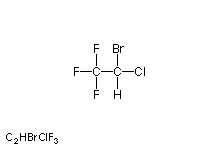
Halothane is a potent inhalation anesthetic widely used for induction and maintenance of general anesthesia. Halothane is non-flammable, induction and recovery are smooth and rapid and the depth of anesthsia is rapidly altered. Inhaled gases are the mainstay of anesthesia and are primarily used for the maintenance of anesthesia after administration of an intravenous agent. The depth of anesthesia can be rapidly altered by changing the concentration of inhaled anesthetic. Most of the agents are rapidly eliminated from the body and donot cause post-operative respirtory depression.
Primary Characteristics
It is of Synthetic origin and belongs to Alkane.
It belongs to Adenosine uptake inhibitor , General Anesthetics-Volatile pharmacological group on the basis of mechanism of action.
Molecular Weight: 197.4 · Solubility in Water: 1 in 400 · Solubility in Alcohol: miscible · Non-proprietary name: Halothane.
Pharmacokinetics
Distribution: Halothane has a volume of distribution is 1 l/kg.
Elimination: it is metabolised via 20% Hepatic, plasma half-life is 2.5 min (alpha phase)16.3 min (beta phase), renal excretion is minor.
Advertisement
Indications
Halothane is primarily indicated in conditions like Induction and maintenance of anaesthesia, Induction of anaesthesia.
Contraindications
Halothane is contraindicated in conditions like Cardiac insufficiency, Malignant hyperthermia.
Dosage
Halothane's dosage details are as follows:
| Dose | Single Dose | Frequency | Route | Instructions |
|---|---|---|---|---|
| Adult Dosage | ||||
| 3 % | 3 % | — | Inhalation | As Required |
| Paediatric Dosage (20kg) | ||||
| 1.25 % | 1.25 % | — | Inhalation | For Maintenance of anaesthesia, As Required |
| 4 % | 4 % | — | Inhalation | For Induction of anaesthesia , As Required |
| Neonatal Dosage (3kg) | ||||
| 1.25 % | 1.25 % | — | Inhalation | For Maintenance of anaesthesia, As Required |
| 1.75 % | 1.75 % | — | Inhalation | For Induction of anaesthesia , As Required |
Drug Interactions
Always consult your physician for the change of dose regimen or an alternative drug of choice that may strictly be required.
Side Effects
Halothane in overdosage may give rise to further complications which include Myocardial depression , Cardiovascular collapse .
Halothane produces potentially life-threatening effects which include Liver damage, Malignant hyperpyrexia. Careful monitoring is needed with proper medical management.
The signs and symptoms that are produced after acute overdosage of Halothane are Death , Cardiac arrhythmias, Pulmonary edema .
Halothane is known to cause more or less tolerable side effects which are usually transient. These include Cardiovascular complications, Shivering .
Warnings / Precautions
Interference in Pathology
Halothane may interfere in the diagnosis of Measurement of Nitrogen & Oxygen partial pressures by Polarographic Methods .
Available Brands
None recorded.
Storage Conditions
Drug Classification
- 1.1.1.2 — Inhalational anesthetics