
Acetylcysteine
Also known as: L-cysteine
Acetylcysteine is the N-acetyl derivative of naturally occuring amino acid L-cysteine. It is a mucolytic agent and works on the lung to make the mucous thin, facilitate their removal and making breathing easier in bronchopulmonary disorders. Acetylcysteine is administered by instillation or nabulization. it is available in combination with hypermellose.
Primary Characteristics
Acetylcysteine is also known as L-cysteine.
It is of Synthetic origin and belongs to Mercaptoalanine.
It belongs to Mucolytic Agents pharmacological group on the basis of mechanism of action and also classified in Antidotes pharmacological group. It is also classified under Respiratory Inhalant Products .
Molecular Weight: 163.2 · pKa: 3.2, 11.2, 9.65 · Solubility in Water: 1 in 8 · Solubility in Alcohol: 1 in 4 · Non-proprietary name: Acetylcysteine · pH: 2 · Isotonic value: 4.58.
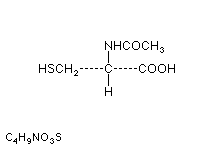
Pharmacokinetics
Absorption: Acetylcysteine has an oral bioavailability is 80%, pre-systemic (first-pass) metabolism accounts for 92.5% (±2.5%).
Distribution: Acetylcysteine has a volume of distribution is 500 ml/kg. plasma protein binding is > 80%.
Elimination: plasma half-life is 0.5-6.6 hr.
Advertisement
Indications
Acetylcysteine is primarily indicated in conditions like Paracetamol overdosage, Paracetamol poisoning, Viscous sputum.
Acetylcysteine is also indicated for secondary conditions like Atelectasis, Cystic fibrosis, Keratoconjuctivitis sicca, Meconium ileus, Surface anaesthetic.
Contraindications
None recorded.
Dosage
Acetylcysteine 's dosage details are as follows:
| Dose | Single Dose | Frequency | Route | Instructions |
|---|---|---|---|---|
| Adult Dosage | ||||
| 3 – 5 ml | — | Every 4h | Inhalation | As 20% solution for mucolytic effect inhaled as nebulizer 3-4 times/day. |
| 6 – 10 ml | — | Every 6h | Nebulizer | 3-5ml of 20% solution as nebulizer for mucolytic effect. 2 Nebulizations in each nostril. |
| 0 – 0 | — | — | Opthalmic | For dry eye associated with abnormal mucus production, acetylcysteine, usually as a 5% solution with hypromellose, is given topically 3 or 4 times daily. |
| 140 – 140 mg/Kg | — | — | PO | This is an initial dose for Paracetamol poisning. Give 140mg/Kg as 5% solution. |
| 70 – 70 mg/Kg | — | Every 4h | PO | For Paracetamol poisning: Give 17 doses of 70mg/Kg after initial dose with an interval of 4 hours. |
| 600 mg | 600 mg | — | PO | As mucolytic in usual dose of 600 mg daily as a single dose or in three divided doses. |
| Paediatric Dosage (20kg) | ||||
| 0.125 mg/kg.min | 0.125 mg/kg.min | — | IV Infusion | Maintenance for 20 Hours, As Required |
| 10 mg/kg.min | 10 mg/kg.min | — | IV Infusion | Initially for 15 Minutes |
| 2 – 3 gm | — | Every 12h | PO | |
| Neonatal Dosage (3kg) | ||||
| 0.125 mg/kg/min | 0.125 mg/kg/min | — | Infusion | Maintenance, over 20 hrs., As required |
| 10 mg/kg/min | 10 mg/kg/min | — | Infusion | Initial , For 15 minutes |
Drug Interactions
None recorded.
Side Effects
Acetylcysteine produces potentially life-threatening effects which include Anaphylactoid reactions . Careful monitoring is needed with proper medical management.
The signs and symptoms that are produced after acute overdosage of Acetylcysteine are Edema, Flushing, Nausea, Vomiting, Bronchospasm, Tachycardia .
Acetylcysteine is known to cause more or less tolerable side effects which are usually transient. These include Nausea, Vomiting .
Warnings / Precautions
Available Brands
Click on a strength to view available brands.
Single Ingredient
Storage Conditions
Drug Classification
- 1.4.2.1 — paracetamol overdose
- 2.21.7 — Other ophthalmologicals
- 3.25.2.2 — Expectorants