
Acetazolamide (Na)
Also known as: Acetazolam
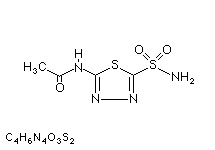
Acetazolamide (Na) is a prototype carbonic anhydrase inhibitor. Acetazolamide (Na) is a non-bacteriostatic sulfonamide possessing a chemical structure and pharmacological activity distinctly diffrent from the bacteriostatic sulfonamides. The sulfonamide group is essential for the activity of acetazolamide. Carbonic anhydrase inhibitors were the forerunners of the modern diuretics. They are unsubstituted sulfonamide derivative and were developed when it was noted that bacteriostatic sulfonamide caused a alkaline diuresis. With the development of newer agent, the carbonic anhydrase inhibitors are now rarely used. It decreases activity of the nerves in the brain which make it useful as an anticonvulsant drug in the treatment of certain seizure disorders such as epilepsy.
Primary Characteristics
Acetazolamide (Na) is also known as Acetazolam.
It is of Synthetic origin and belongs to Sulphonamide.
It is classified in Diuretics pharmacological group.
Molecular Weight: 222.25 · pKa: 7.2, 9.0 · Solubility in Water: >1 in 1000 · Solubility in Alcohol: 1 in 400 · Non-proprietary name: Acetazolamide (Na) · Isotonic value: 3.85.
Pharmacokinetics
Absorption: Acetazolamide (Na) has an oral bioavailability is 100%.
Distribution: Acetazolamide (Na) has a volume of distribution is 0.2 l/kg. plasma protein binding is 70-90%.
Elimination: plasma half-life is 6-9 hr, renal excretion is 70-90%.
Advertisement
Indications
Acetazolamide (Na) is primarily indicated in conditions like Edema, Epilepsy, Fluid retention, Glucoma, Oedema.
Acetazolamide (Na) is also indicated for secondary conditions like Mountain sickness, Periodic paralysis.
Contraindications
Acetazolamide (Na) is contraindicated in conditions like Renal hyperchloremic acidosis, Addison's disease, Liver diseases, Close-angle glaucoma, Hepatic encephalopathy, Kidney disease.
Dosage
Acetazolamide (Na)'s dosage details are as follows:
| Dose | Single Dose | Frequency | Route | Instructions |
|---|---|---|---|---|
| Adult Dosage | ||||
| 250 – 1000 mg | — | — | IV | |
| 625 mg | 625 mg | — | PO | For glucoma and epilepry 250-1000mg/day in divided doses |
| Paediatric Dosage (20kg) | ||||
| 4 mg/kg | 4 mg/kg | — | oral | Maximum 750mg/day in 2-3 doses |
| 10 – 20 mg/kg/day | — | — | PO | For 1 month-12 Years. Give in 2-4 divided doses. (maximum 750mg/day) |
| 4 mg/kg | 4 mg/kg | — | PO | |
| Neonatal Dosage (3kg) | ||||
| 4 mg/kg | 4 mg/kg | Every 8h | Intravenous | |
| 4 mg/kg | 4 mg/kg | Every 8h | Oral | |
Drug Interactions
Always consult your physician for the change of dose regimen or an alternative drug of choice that may strictly be required.
Side Effects
Acetazolamide (Na) in overdosage may give rise to further complications which include Growth retardation .
Acetazolamide (Na) produces potentially life-threatening effects which include Blood disorders, Skin toxicity, Urinary stone formation, Aplastic Anemia , Stevens Johnson syndrome, Stevens Johnson syndrome, Potassium loss, Aplastic anemia, Metabolic acidosis. Careful monitoring is needed with proper medical management.
The signs and symptoms that are produced after acute overdosage of Acetazolamide (Na) are Disorientation , Drowsiness, Drowsiness.
Acetazolamide (Na) is known to cause more or less tolerable side effects which are usually transient. These include Ataxia, bone marrow depression, dizziness, Drowsiness, Excitement, Fatigue, Fever, Flushing, GI upset, Headache, Hyperphosphatemia, Hyperpnea, Irritability, Paresthesias, Rashes , Thirst.
Warnings / Precautions
Interference in Pathology
Acetazolamide (Na) may interfere in the diagnosis of False -ve values for the estimation of urinary protein, serum non-protein and for serum uric acid .
Available Brands
Click on a strength to view available brands.
Single Ingredient
Storage Conditions
Drug Classification
- 1.16.5 — Carbonic anhydrase inhibitors
- 2.21.4.4 — Carbonic anhydrase inhibitors
Manufacturers
Manufacturers of Acetazolamide (Na) in Pakistan: