
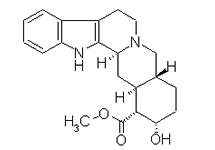
Yohimbine (HCl)
An indole alkaloid, is an alpha-2 selective antagonist. It has no established clinical role. Theoretically, it could be useful in autonomic insufficiency by promoting neurotransmitter release through blockade of presynaptic alpha-2 receptors.
Primary Characteristics
It is of Natural origin and belongs to Indole Alkaloid.
Molecular Weight: 390.9 · pKa: 6.3 · Solubility in Water: 1 in 120 · Solubility in Alcohol: 1 in 400 · Non-proprietary name: Yohimbine (HCl).
Pharmacokinetics
Distribution: Yohimbine (HCl) has a volume of distribution is 71 litre.
Elimination: plasma half-life is 0.6 hr, renal excretion is 0.5 - 1 % unchanged.
Advertisement
Indications
Yohimbine (HCl) is primarily indicated in conditions like Organic and psychosomatic impotance, Orthostatic hypotension.
Yohimbine (HCl) is also indicated for secondary conditions like Obesity.
Contraindications
Yohimbine (HCl) is contraindicated in conditions like Renal diseases.
Dosage
None recorded.
Drug Interactions
None recorded.
Side Effects
Yohimbine (HCl) in overdosage may give rise to further complications which include Loss of memory, Atrial fibrillation .
Yohimbine (HCl) produces potentially life-threatening effects which include Tachycardia, Cardiac arrhythmia, Hypertension. Careful monitoring is needed with proper medical management.
The signs and symptoms that are produced after acute overdosage of Yohimbine (HCl) are Hypertension, Paresthesia, Teichopsia, Chest pain, Nausea, Tachycardia , Anxiety , Weakness , Palpitations , Headache.
Yohimbine (HCl) is known to cause more or less tolerable side effects which are usually transient. These include Incoordination , Increased BP , Increased heart rate, Increased salivation, Paresthesias, Rhinorrhea.
Warnings / Precautions
Available Brands
Storage Conditions
Drug Classification
- 1.29 — Drugs used in renal, bladder, and prostatic disorders