
Oxacillin
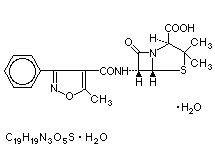
Oxacillin is an isoxazolyl antistaphylococcal penicillin used similarly to fluclit. Oxacillin is mainly used in the treatment of infections caused by penicillinase-resistant strains of staphylococci, including bacteremia, skin and soft-tissue infections, respiratory tract infections, bone and joint infections, and urinary tract infections. It inhibits the third and final stage of bacterial cell wall synthesis by preferentially binding to specific penicillin-binding proteins (PBPs) that are located inside the bacterial cell wall. Like all ß-lactam antibiotics, it's ability to interfere with PBP-mediated cell wall synthesis ultimately leads to cell lysis. It was approved by the FDA in 1962.
Primary Characteristics
It is of Synthetic origin and belongs to isooxyc Penicillin.
Molecular Weight: 441.4 · Solubility in Water: freely · Solubility in Alcohol: slighty · Non-proprietary name: Oxacillin · pH: 4.5.
Pharmacokinetics
Distribution: Oxacillin has a plasma protein binding is 93 %.
Elimination: plasma half-life is 0.5 - 1 hr, renal excretion is 20 - 30 % (oral), 40 % (IM).
Advertisement
Indications
Oxacillin is primarily indicated in conditions like Staphylococcal infections.
Contraindications
Oxacillin is contraindicated in conditions like Allergy, Hypersensitivity to any component of product.
Dosage
Oxacillin's dosage details are as follows:
| Dose | Single Dose | Frequency | Route | Instructions |
|---|---|---|---|---|
| Adult Dosage | ||||
| 375 mg | 375 mg | Every 6h | IV | For mild to moderate infections: should be given every 4-6 hrs. |
| 1 g | 1 g | Every 6h | IV or IM | For severe infections: should be given every 4-6 hrs. |
| Paediatric Dosage (20kg) | ||||
| 500 – 250 mg | — | Every 6h | IV or IM | For children weighing 40kg 1g every 4 to 6 hrs can be given in severe infections. |
| 12.5 mg/kg | 12.5 mg/kg | Every 6h | IV or IM | For children less then 40kg. 100mg/kg/day can be given in severe infections. |
| Neonatal Dosage (3kg) | ||||
| No data. | ||||
Drug Interactions
Always consult your physician for the change of dose regimen or an alternative drug of choice that may strictly be required.
Side Effects
Oxacillin in overdosage may give rise to further complications which include Hepatitis , Cholestatic jaundice , Cholestatic jaundice , Neutropenia , Agranulocytosis .
Oxacillin produces potentially life-threatening effects which include Anaphylactic shock. Careful monitoring is needed with proper medical management.
The signs and symptoms that are produced after acute overdosage of Oxacillin are Seizures, Skin rashes, Confusion , Behavioural changes.
Oxacillin is known to cause more or less tolerable side effects which are usually transient. These include GI upset, Hypersensitivity reactions, Nausea, Skin RashX, Stomach pain, Vaginal Itching, Vomiting .
Warnings / Precautions
Interference in Pathology
Oxacillin may interfere in the diagnosis of Urinanalysis , Liver Function Test (LFT) , Periodic BUN and creatinine determinations.
Available Brands
None recorded.
Storage Conditions
Drug Classification
- 1.6.2.1.1 — Penicillins