
Tacrolimus
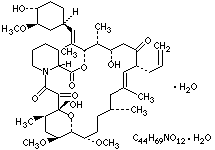
A potent macrolide immunosuppressant derived from Streptom yces tsukubaensis. It prevents or reverses rejection in patients receiving organ transplants. On weight basis tacrolimus is 10-100 times more potent than cyclosporine in inhibiting immune responses. Nephrotoxicity, neurotoxicity, and gastrointestinal complaints are its common side effects.
Primary Characteristics
It is of Synthetic origin.
Molecular Weight: 821 · Solubility in Water: 1 in 83300 · Solubility in Alcohol: 1 in 2.7 · Non-proprietary name: Tacrolimus.
Pharmacokinetics
Absorption: Tacrolimus has an oral bioavailability is 25% (±10%).
Distribution: Tacrolimus has a volume of distribution is 1300 litre (Plasma), 50 Litre (Blood). plasma protein binding is 98.8 %.
Elimination: plasma half-life is 8.5 hr, renal excretion is <1%.
Advertisement
Indications
Tacrolimus is primarily indicated in conditions like Atopic dermatitis, Kidney transplantation, Liver transplantation.
Tacrolimus is also indicated for secondary conditions like Graft versus host disease, Immune disorders, Liver transplant, Organ grafts, Renal transplant.
Contraindications
Tacrolimus is contraindicated in conditions like Hypersensitivity, Pregnancy.
Dosage
Tacrolimus's dosage details are as follows:
| Dose | Single Dose | Frequency | Route | Instructions |
|---|---|---|---|---|
| Adult Dosage | ||||
| 150 mcg/kg | 150 mcg/kg | Every 6h | PO/IV-Inf | In liver transplant starting 6 hrs after transplantation. |
| 225 mcg/kg | 225 mcg/kg | Every 6h | PO/IV-Inf | In renal transplant starting 6 hrs after transplantation. |
| Paediatric Dosage (20kg) | ||||
| No data. | ||||
| Neonatal Dosage (3kg) | ||||
| No data. | ||||
Drug Interactions
Always consult your physician for the change of dose regimen or an alternative drug of choice that may strictly be required.
Side Effects
Tacrolimus in overdosage may give rise to further complications which include Hyperglycemia , Hypertension , Renal insufficiency, Tublar necrosis, Angina , Anuria, Renal failure , Confusion , Anxiety , Leucopenia, Tremors , Hallucinations , Tachycardia , Leucocytosis , Oliguria .
Tacrolimus produces potentially life-threatening effects which include Coma, Convulsions , Anaphylactic shock, Renal failure, Psychosis, Neurotoxicity , Tubular necrosis, Speech disorder. Careful monitoring is needed with proper medical management.
Tacrolimus is known to cause more or less tolerable side effects which are usually transient. These include Constipation , Diarrhea, Headache, Nausea.
Warnings / Precautions
Interference in Pathology
Tacrolimus may interfere in the diagnosis of Abnormal LFTs , Increased level of Blood urea nitrogen (BUN) concentrations, Increased concentration of creatinine kinase.
Available Brands
Storage Conditions
Drug Classification
- 1.8.1 — Immunomodulators