
Carbenicillin (Na)
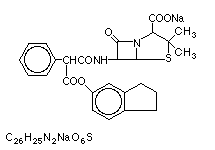
Carbenicillin is a semisynthetic penicillin. Alexander Fleming reported his discovery of penicillin in 1929. Chain, Flory and their associates succeeded in producing significant quantities of the first penicillins from the cultures of Penicillium notatum in 1940. Ten years later virtually unlimited quantities of penicillin G were available for clinical use. Carbenecillin is the first antipseudomonal carboxypenicillin. Carbenicillin is effective against gram negative bacteria and also inhibiting the growth of some gram positive bacteria.
Primary Characteristics
It is of Semi Synthetic origin and belongs to Beta Lactam.
It belongs to Peptidoglycan synthesis inhibitor pharmacological group on the basis of mechanism of action and also classified in Antibiotic, Penicillin pharmacological group.
Molecular Weight: 422.4 · pKa: 2.6 · Solubility in Water: 1 in 1.2 · Solubility in Alcohol: 1 in 25 · Non-proprietary name: Carbenicillin (Na).
Pharmacokinetics
Distribution: Carbenicillin (Na) has a volume of distribution is 0.18 l/kg. plasma protein binding is 50%.
Elimination: plasma half-life is 1-1.5 hr, renal excretion is largely.
Advertisement
Indications
Carbenicillin (Na) is primarily indicated in conditions like Bacterial infections, Meningitis, Urinary tract infection.
Contraindications
Carbenicillin (Na) is contraindicated in conditions like Haemophilia.
Dosage
Carbenicillin (Na)'s dosage details are as follows:
| Dose | Single Dose | Frequency | Route | Instructions |
|---|---|---|---|---|
| Adult Dosage | ||||
| 42.85 mg/kg | 42.85 mg/kg | Every 6h | Slow IV | As Required |
| Paediatric Dosage (20kg) | ||||
| 400 mg/kg | 400 mg/kg | — | Intra Venous | As Required |
| Neonatal Dosage (3kg) | ||||
| No data. | ||||
Drug Interactions
Always consult your physician for the change of dose regimen or an alternative drug of choice that may strictly be required.
Side Effects
Carbenicillin (Na) in overdosage may give rise to further complications which include Cardiac insufficiency , Granulocytopenia , Coagulation disorder , Hypokalemia , Stevens johnson syndrome .
The signs and symptoms that are produced after acute overdosage of Carbenicillin (Na) are Epileptic seizures, Neurotoxic reactions.
Carbenicillin (Na) is known to cause more or less tolerable side effects which are usually transient. These include Abdominal pain, Bullous rash, Diarrhea, Edema, Elevation of liver enzymes, Flatulence, Fluid retention, Nausea, Phlebitis , Vomiting .
Warnings / Precautions
Interference in Pathology
Carbenicillin (Na) may interfere in the diagnosis of Impair the in-vitro assay of aminoglycosides .
Available Brands
None recorded.
Storage Conditions
Drug Classification
- 1.6.2.1.1 — Penicillins