
Ketanserin (Tartrate)
Chemically Ketanserin (Tartrate) is (+)-3-[2-[4-fluorobenzoyl)-1-piperidinyl]-2, 4 [1H, 3H]-quinazoline-dione. Ketanserin (Tartrate) is prepared by chemical synthesis and the dextrorotatary stereoisomer is used clinically. Ketanserin (Tartrate) is a serotonin antagonist with a high affinity for peripheral serotonin-2 (5-HT-2) receptors and thus inhibits serotonin-induced vasoconstriction, bronchoconstriction and platelet aggregation.it has also some a-1 antagonist and histamine H-1antagonist properties, but the clinical significance of these is controversial. Ketanserin is used in the management of hypertension and has also been tried in a variety of other conditions.
Primary Characteristics
It is of Synthetic origin and belongs to 2.4(1h,3h) Quinazolivedione.
It belongs to 5HT-2 + alpha adrenergic antagonist pharmacological group on the basis of mechanism of action and also classified in Antihypertensive Agents pharmacological group. It is also classified under Psychotherapeutic Drugs .
Molecular Weight: 545.52 · pKa: 7.5 · Solubility in Water: 1 in 42 · Solubility in Alcohol: 1 in 417 · Non-proprietary name: Ketanserin (Tartrate).
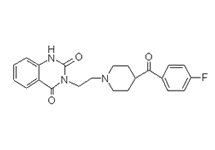
Pharmacokinetics
Absorption: Ketanserin (Tartrate) has an oral bioavailability is 50% (±50%), pre-systemic (first-pass) metabolism accounts for 25% (±25%).
Distribution: Ketanserin (Tartrate) has a volume of distribution is 3-6 l/kg. plasma protein binding is 95%.
Elimination: it is metabolised via Hepatic (extensively), plasma half-life is 10-18 hr, renal excretion is 68%.
Advertisement
Indications
Ketanserin (Tartrate) is primarily indicated in conditions like Acute hypertensive episodes, Essential hypertension.
Ketanserin (Tartrate) is also indicated for secondary conditions like Bronchospasm, Vasodilator.
Contraindications
Ketanserin (Tartrate) is contraindicated in conditions like Hypersensitivity to any component of product.
Dosage
Ketanserin (Tartrate)'s dosage details are as follows:
| Dose | Single Dose | Frequency | Route | Instructions |
|---|---|---|---|---|
| Adult Dosage | ||||
| 40 mg | 40 mg | — | ||
| 0.142 mg/kg | 0.142 mg/kg | — | IM | Every 15-30 minutes, As Required |
| 0.235 mg/kg.min | 0.235 mg/kg.min | — | IV Inf | As Required |
| 20 mg | 20 mg | Every 12h | PO | For 2-4 weeks |
| Paediatric Dosage (20kg) | ||||
| No data. | ||||
| Neonatal Dosage (3kg) | ||||
| No data. | ||||
Drug Interactions
None recorded.
Side Effects
Ketanserin (Tartrate) in overdosage may give rise to further complications which include Ventricular tachycardia .
Ketanserin (Tartrate) produces potentially life-threatening effects which include Ventricular arrhythmias. Careful monitoring is needed with proper medical management.
The signs and symptoms that are produced after acute overdosage of Ketanserin (Tartrate) are Drowsiness, Drowsiness, Visual distrubances, Syncope , Sleepiness.
Ketanserin (Tartrate) is known to cause more or less tolerable side effects which are usually transient. These include Dizziness, Drowsiness, Dry mouth, Fatigue, GI disturbance, Headache, Lack of concentration, Light headedness, Sedation .
Warnings / Precautions
Available Brands
None recorded.
Storage Conditions
Drug Classification
- 1.12.8 — Other cardiovascular preparations