
Primary Characteristics
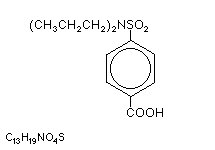
It is of Semi Synthetic origin and belongs to Benzoic Acid.
It belongs to Renal tubular anion resorption inhibitor pharmacological group on the basis of mechanism of action.
Molecular Weight: 285.4 · pKa: 3.4 · Solubility in Water: almost Insoluble · Solubility in Alcohol: 1 in 25 · Non-proprietary name: Probenecid.
Pharmacokinetics
Absorption: Probenecid has an oral bioavailability is 100%.
Distribution: Probenecid has a volume of distribution is 11 litre. plasma protein binding is 90 %.
Elimination: it is metabolised via Hepatic, plasma half-life is 4 - 17 hr, renal excretion is 90%.
Advertisement
Indications
Probenecid is primarily indicated in conditions like Galactorrhoea, Gout, Hypogonadism, Infertility, Infertility without hyperprolactinaemia.
Probenecid is also indicated for secondary conditions like Infections, Prostate cancer, flare with initial gonadorelin therapy.
Contraindications
Probenecid is contraindicated in conditions like Peptic ulcer, Renal failure, Blood dyscrasias, Acute gout attack, Kidney stone.
Dosage
Probenecid's dosage details are as follows:
| Dose | Single Dose | Frequency | Route | Instructions |
|---|---|---|---|---|
| Adult Dosage | ||||
| 250 mg | 250 mg | Every 2h | PO | Initially for Several Weeks |
| 1250 mg | 1250 mg | Every 2h | PO | Maintenance 2gm will be given in 4 divided doses. |
| Paediatric Dosage (20kg) | ||||
| 10 mg/kg | 10 mg/kg | Every 6h | Oral | Maintenance, As Required |
| 25 mg/kg | 25 mg/kg | — | Oral | Initially Once (Rec for Paeds over 2 Yrs) |
| Neonatal Dosage (3kg) | ||||
| 0 – 0 | — | — | Not recommended in this age group | |
Drug Interactions
Always consult your physician for the change of dose regimen or an alternative drug of choice that may strictly be required.
Side Effects
Probenecid produces potentially life-threatening effects which include Aplastic Anemia , Hemolytic anemia, Leucopenia , Hepatic necrosis, Anaphylactic reactions. Careful monitoring is needed with proper medical management.
The signs and symptoms that are produced after acute overdosage of Probenecid are Convulsions , Stupor , CNS stimulation, Vomiting, Coma, Tonic-clonic seizures.
Probenecid is known to cause more or less tolerable side effects which are usually transient. These include Alopecia, Anorexia , Dermatitis, Dizziness, Fever, Flushing, Headache, Nausea, Nephrolithiasis , Nephrotic syndrome, Pruritus , Rashes , Sore gums, Stevens Johnson syndrome, Urinary frequency, Urticaria, Vomiting .
Warnings / Precautions
Interference in Pathology
Probenecid may interfere in the diagnosis of Glucose Test .
Available Brands
None recorded.
Storage Conditions
Drug Classification
- 1.2.3 — Antigout preparations