
Prednisolone and Prednisone
Also known as: Delthydrocortisone, Metacortandralone
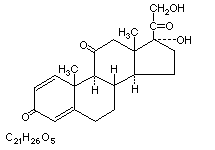
Prednisone is the most commonly-prescribed oral corticosteroid. Chemically Prednisolone and Prednisone is 11ß, 17, 21-trihydroxypregna-1, 4-diene-3, 20-dione. The drug is metabolized in the liver to its active form, prednisolone. Relative to hydrocortisone, prednisone is roughly 4 times as potent as a glucocorticoid. Prednisolone and Prednisone is intermediate between hydrocortisone and dexamethasone in duration of action. Prednisone is used in many conditions, including allograft rejection, asthma, systemic lupus erythematosus, and many other inflammatory states. It has very little mineralocorticoid activity, so Prednisolone and Prednisone is not used in the management of adrenal insufficiency unless a more potent mineralocorticoid is administered concomitantly.
Primary Characteristics
Prednisolone and Prednisone is also known as Delthydrocortisone, Metacortandralone.
It is of Synthetic origin and belongs to Steroid.
It belongs to Glucocorticoid agonist pharmacological group on the basis of mechanism of action and also classified in Corticosteroid Opthalmic pharmacological group.
Molecular Weight: 360.4 · pKa: not ionizable · Solubility in Water: 1:1300 · Solubility in Alcohol: 1:35 · Non-proprietary name: Prednisolone and Prednisone.
Pharmacokinetics
Absorption: Prednisolone and Prednisone has an oral bioavailability is 100%, pre-systemic (first-pass) metabolism accounts for 12.5% (±7.5%).
Distribution: Prednisolone and Prednisone has a volume of distribution is 2.8 litre. plasma protein binding is 70 - 90 %.
Elimination: plasma half-life is 2.1 - 3.5 hr, renal excretion is > 90 %.
Advertisement
Indications
Prednisolone and Prednisone is primarily indicated in conditions like Adrenal insufficiency, Asthma, Blood malignancies, Connective tissue diseases, Liver diseases, Ocular diseases, Renal diseases, Respiratory disease, Suppression of inflammatory and allergic disorders.
Contraindications
Prednisolone and Prednisone is contraindicated in conditions like Diabetes mellitus, Peptic ulcer, Psychosis, Osteoporosis, Infections.
Dosage
Prednisolone and Prednisone's dosage details are as follows:
| Dose | Single Dose | Frequency | Route | Instructions |
|---|---|---|---|---|
| Adult Dosage | ||||
| 32.5 mg | 32.5 mg | — | PO,IM | In divided doses. |
| 0.75 % | 0.75 % | Every 8h | Topical | |
| Paediatric Dosage (20kg) | ||||
| 312.5 ug/kg | 312.5 ug/kg | Every 8h | Intra Muscular | |
| 312.5 ug/kg | 312.5 ug/kg | Every 8h | Oral | |
| 0.5 % | 0.5 % | Every 8h | Topical | |
| Neonatal Dosage (3kg) | ||||
| 0 – 0 | — | — | Shoul be avoided under 1 year | |
Drug Interactions
Always consult your physician for the change of dose regimen or an alternative drug of choice that may strictly be required.
Side Effects
Prednisolone and Prednisone in overdosage may give rise to further complications which include Myopathy , Growth retardation , Subcapsular cataract , Glaucoma , Peptic ulceration , Aseptic bone necrosis , Ocular hypertension , Pancreatic disturbance , Oedema , Moon face , Osteoporosis .
Prednisolone and Prednisone produces potentially life-threatening effects which include Adrenal Insufficiency . Careful monitoring is needed with proper medical management.
Prednisolone and Prednisone is known to cause more or less tolerable side effects which are usually transient. These include Euphoria, Increased appetite, Insomnia, Nausea, Nervousness, Nocturia , Obesity, sodium retention, Vomiting .
Warnings / Precautions
Interference in Pathology
Prednisolone and Prednisone may interfere in the diagnosis of Measurement of Plasma Cortisol , Glucose Tolerance Test .
Available Brands
Storage Conditions
Drug Classification
- 1.8.3 — Hormones and antihormones
- 2.18.1 — Corticosteroids, systemic