
Miconazole (Nitrate)
Miconazole (Nitrate) is imidazole-type antifungal. When miconazole was first released, it was hoped it would replace amphotericin B as a parenteral antifungal agent. It was soon discovered, however, that miconazole not only failed to offer the same efficacy as amphotericin B, but also possessed intrinsic toxicities after IV administration. While miconazole is still marketed in a parenteral formulation, it most commonly is used topically and intravaginally. Miconazole was approved by the FDA in 1974it was one of the first azole antifunfal agent to become widely used for treating mycoses. Miconazole (Nitrate) is a topically used azole. Like other azole antifungals, miconazole exerts its effect by altering the fungal cell membrane. Miconazole inhibits ergosterol synthesis by interacting with 14a demethylase, a cytochrome P-450 enzyme that is necessary for the conversion of lanosterol to ergosterol, an essential component of the membrane. Inhibition of ergosterol synthesis results in increased cellular permeability, causing leakage of cellular contents. Miconazole does not appear to have the same effect on human cholesterol synthesis.
Primary Characteristics
Miconazole (Nitrate) is also known as Miconazole.
It is of Synthetic origin and belongs to Azole.
It is classified in Antifungals pharmacological group.
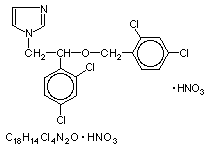
Molecular Weight: 479.1 · pKa: 6.65 · Solubility in Alcohol: 1 in 140 · Non-proprietary name: Miconazole (Nitrate).
Pharmacokinetics
Absorption: Miconazole (Nitrate) has an oral bioavailability is 20%.
Distribution: Miconazole (Nitrate) has a volume of distribution is 20 l/kg. plasma protein binding is 92 %.
Elimination: it is metabolised via Hepatic, plasma half-life is 24.1 hr, renal excretion is 20 %.
Advertisement
Indications
Miconazole (Nitrate) is primarily indicated in conditions like Balanitis, Candidosis, Fungal infection, Vulvo-vaginal candidosis.
Contraindications
Miconazole (Nitrate) is contraindicated in conditions like Hypersensitivity to any component of product.
Dosage
Miconazole (Nitrate)'s dosage details are as follows:
| Dose | Single Dose | Frequency | Route | Instructions |
|---|---|---|---|---|
| Adult Dosage | ||||
| 2 % | 2 % | — | Ophthalmic | As required. |
| 250 mg | 250 mg | Every 6h | PO | |
| 100 mg | 100 mg | Every 24h | Rectal | For 14 days. |
| 2 % | 2 % | Every 24h | Topical | Once daily |
| Paediatric Dosage (20kg) | ||||
| 8.3 – 0.5 mg/kg.min | — | Every 8h | IV Infusion | Infuse over 30 Min |
| 7.5 ml | 7.5 ml | Every 6h | Oral gel | |
| 2 % | 2 % | Every 24h | Topical | - |
| Neonatal Dosage (3kg) | ||||
| 0.415 mg/kg.min | 0.415 mg/kg.min | Every 8h | IV Infusion | Infuse over 30 Min |
| 2 % | 2 % | Every 24h | Topical | - |
Drug Interactions
Always consult your physician for the change of dose regimen or an alternative drug of choice that may strictly be required.
Side Effects
Miconazole (Nitrate) in overdosage may give rise to further complications which include Cardiac arrhythmias, Hepatitis , Cardiac arrhythmias , Phlebitis, Pruritis , Arachnoiditis .
Miconazole (Nitrate) produces potentially life-threatening effects which include Anaphylaxis , Cardiac Arrest , Cardiac arrest. Careful monitoring is needed with proper medical management.
The signs and symptoms that are produced after acute overdosage of Miconazole (Nitrate) are Vomiting, Diarrhea, Arrhythmias.
Miconazole (Nitrate) is known to cause more or less tolerable side effects which are usually transient. These include Anorexia , Drowsiness, Flushing, GI upset, Local irritation, Nausea and vomiting, Rashes .
Warnings / Precautions
Available Brands
Storage Conditions
Drug Classification
- 1.6.3 — Antifungal drugs
- 2.13.1 — Antifungals, topical
- 3.22.2 — Gynecological anti-infectives