
Mezlocillin
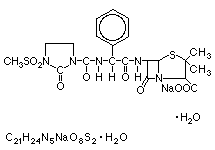
Mezlocillin sodium is an antibiotic that belongs to a group called Penicillins. It is a parenteral, semisynthetic, extended-spectrum acylureidopenicillin. Clinically, Mezlocillin is used in the treatment of intra-abdominal infections, respiratory and urinary tract infections, skin and soft-tissue infections, and other infections caused by susceptible bacteria. Mezlocillin is often used in combination with an aminoglycoside to treat systemic Pseudomonas infections. Mezlocillin is not effective against staphylococcus. It was approved by the FDA in 1981. Mezlocillin is a beta-lactam antibacterial antibiotic. Mezlocillin is mainly bactericidal. It inhibits the third and final stage of bacterial cell wall synthesis by preferentially binding to specific penicillin-binding proteins (PBPs) that are located inside the bacterial cell wall. Penicillin-binding proteins are responsible for several steps in the synthesis of the cell wall.
Primary Characteristics
Mezlocillin is also known as Mezlocillin Sodium.
It is of Semi Synthetic origin and belongs to Penicillin.
It belongs to Peptidoglycan synthesis inhibitor pharmacological group on the basis of mechanism of action and also classified in Antibiotics pharmacological group.
Molecular Weight: 579.6 · pKa: 2.7 · Solubility in Water: 1 in 3 · Non-proprietary name: Mezlocillin.
Pharmacokinetics
Absorption: Mezlocillin has an oral bioavailability is 0.5% (±0.5%), pre-systemic (first-pass) metabolism accounts for 85%.
Distribution: Mezlocillin has a volume of distribution is 0.38 - 0.55 l/kg. plasma protein binding is 16-42%.
Elimination: it is metabolised via 20-30% hepatic, plasma half-life is 1 hr, renal excretion is 55%.
Advertisement
Indications
Mezlocillin is primarily indicated in conditions like Bacterial infections, Biliary tract infections, Gonorrhoea, Intra-abdominal infections, Lower respiratory tract infections, Respiratory tract infections, Septicaemia, UTI.
Mezlocillin is also indicated for secondary conditions like Meningitis, Osteomyelitis, Pelvic infections, Soft tissue infections.
Contraindications
Mezlocillin is contraindicated in conditions like Hypersensitivity.
Dosage
Mezlocillin's dosage details are as follows:
| Dose | Single Dose | Frequency | Route | Instructions |
|---|---|---|---|---|
| Adult Dosage | ||||
| 1.5 g | 1.5 g | Every 6h | For uncomplicated gonorrhoea. | |
| 1.75 g | 1.75 g | Every 6h | IM,IV | For unconplicated urinary tract infection |
| 4 g | 4 g | Every 6h | IV | For prophylaxis of Infection during surgery. |
| 250 mg/kg | 250 mg/kg | Every 6h | IV | Individed doses, |
| Paediatric Dosage (20kg) | ||||
| 50 mg/kg | 50 mg/kg | Every 4h | Intamuscular | |
| 50 mg/kg | 50 mg/kg | Every 4h | IV infusion | Infuse over 30 min. |
| Neonatal Dosage (3kg) | ||||
| 50 mg/kg | 50 mg/kg | Every 4h | Intamuscular | |
| 50 mg/kg | 50 mg/kg | Every 4h | IV infusion | Infuse over 30 min. |
Drug Interactions
Always consult your physician for the change of dose regimen or an alternative drug of choice that may strictly be required.
Side Effects
Mezlocillin in overdosage may give rise to further complications which include Thrombocytopenia , Cholestatic jaundice , Cholestatic jaundice , Leucopenia, Elevated SGPT & SGOT, Interstitial nephritis , Acute interstitial nephritis , Hyperbilirubinemia, Vaginitis .
Mezlocillin produces potentially life-threatening effects which include Anaphylaxis . Careful monitoring is needed with proper medical management.
The signs and symptoms that are produced after acute overdosage of Mezlocillin are Coma, Seizures, Encephalopathy, Hallucinations , Hypokalemia , Agitation, Stupor , Agitation.
Mezlocillin is known to cause more or less tolerable side effects which are usually transient. These include Anorexia , Cramps , Dizziness, Erythema, Fatigue, Insomnia, Nausea and vomiting, Thrombophlebitis .
Warnings / Precautions
Interference in Pathology
Mezlocillin may interfere in the diagnosis of Sulphosalicylic acid precipitation test for proteinuria .
Available Brands
None recorded.
Storage Conditions
Drug Classification
- 1.6.2.1.1 — Penicillins