
Metoclopramide (HCl)
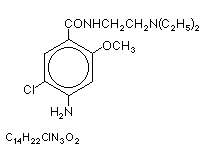
Metoclopramide (HCl) is antiemetic with dopamine antagonist action in brain and peripheral effect on gastro-intestinal tract where it stimulates motility to improve gastric emptying and intestinal transit. Metoclopramide (HCl) is used to treat nausea, and vomiting of most causesand as an adjunct to X-ray examination of the gut. Metoclopramide (HCl) is given both orally and parentrally.
Primary Characteristics
Metoclopramide (HCl) is also known as Metoclopramide.
It is of Synthetic origin and belongs to Benzamide.
It belongs to D2 antagonist pharmacological group on the basis of mechanism of action and also classified in GI Agent, Prokinetic pharmacological group. It is also classified under Histamine (H-2) Antagonists .
Molecular Weight: 354.3 · pKa: 4.45, 9.2 · Solubility in Water: Very soluble · Solubility in Alcohol: Freely soluble · Non-proprietary name: Metoclopramide (HCl).
Pharmacokinetics
Absorption: Metoclopramide (HCl) has an oral bioavailability is 65% (±33%), pre-systemic (first-pass) metabolism accounts for 34% (±34%).
Distribution: Metoclopramide (HCl) has a volume of distribution is 2.2-3.4 l/kg. plasma protein binding is 40%.
Elimination: it is metabolised via Hepatic(extensively), plasma half-life is 2.6-5.4 hr, renal excretion is 80%.
Advertisement
Indications
Metoclopramide (HCl) is primarily indicated in conditions like Delayed gastric emptying, Diagnostic procedures, Flatulence, Gastritis, GI motality disorder, Heart burn, Hiccup in palliative care, Migraine, Nausea and vomiting, Nausea and vomiting (chemotherapy induced), Reflux oesophagitis.
Metoclopramide (HCl) is also indicated for secondary conditions like Defective lactation, Hiccup due to gastric distension in palliative care, Postural hypotension, Psychosis.
Contraindications
Metoclopramide (HCl) is contraindicated in conditions like Parkinsonism, Phaeochromocytoma, Dystonia, Pyloric stenosis.
Dosage
Metoclopramide (HCl)'s dosage details are as follows:
| Dose | Single Dose | Frequency | Route | Instructions |
|---|---|---|---|---|
| Adult Dosage | ||||
| 3 mg | 3 mg | Every 8h | PO,IV,IM | Renal dysfunction: decrease dose. |
| Paediatric Dosage (20kg) | ||||
| 0.15 mg/kg | 0.15 mg/kg | Every 8h | Intra Muscular | - |
| 0.15 mg/kg | 0.15 mg/kg | Every 8h | Intra Venous | - |
| 0.15 mg/kg | 0.15 mg/kg | Every 8h | Oral | - |
| Neonatal Dosage (3kg) | ||||
| 0.1 mg/kg | 0.1 mg/kg | Every 8h | Intramuscular | |
| 0.1 mg/kg | 0.1 mg/kg | Every 8h | Intravenous | |
| 0.1 mg/kg | 0.1 mg/kg | Every 8h | Oral | |
Drug Interactions
Always consult your physician for the change of dose regimen or an alternative drug of choice that may strictly be required.
Side Effects
Metoclopramide (HCl) in overdosage may give rise to further complications which include Tardive dyskinesia , Parkinsonism , Acute dystonia , Acute porphyria, Acute dyskinesia, Extrapyramidal reactions.
The signs and symptoms that are produced after acute overdosage of Metoclopramide (HCl) are Tachycardia , Drowsiness, Drowsiness, Dystonia.
Metoclopramide (HCl) is known to cause more or less tolerable side effects which are usually transient. These include Akathisia, Diarrhea, Drowsiness, Galactorrhea, Gynecomastia, Hyperprolactinemia, Hypertension , Hypotension , Impotence, Increase in heart rate , Mental disturbances, neuroleptic disorder, Skin rash.
Warnings / Precautions
Available Brands
Storage Conditions
Drug Classification
- 1.17.2 — Antiemetics & antinauseants
Manufacturers
Manufacturers of Metoclopramide (HCl) in Pakistan: