
Lisinopril
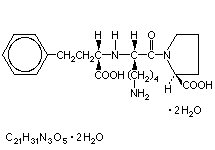
Lisinopril is an oral angiotensin-converting enzyme (ACE) inhibitor used in the treatment of hypertension and congestive heart failure (CHF). Chemically, Lisinopril is the lysine ester of enalaprilat, the active moiety of enalapril. ACE inhibitors prevent conversion of certain enzymes in the body and prevents constriction of blood vessels and lower the blood pressure and makes the heart beat stronger. Lisinopril is active without metabolism and its (S) epimer is used clinicaly. Lisinopril is a lysine derivative of enalaprilat. Lisinopril is administered orally. It has a slower onset and a longer duration of action than either captopril or enalapril and can be dosed once daily.it was originally approved by the FDA in December 1987 for use in the treatment of hypertension. In July 1993, it was also approved for use in the treatment of CHF. Finally, in November 1995, it was approved to improve survival in hemodynamically stable patients within 24 hours post-myocardial infarction.it competes with angiotensin I for its binding site on the angiotensin-converting enzyme (ACE). As a result, the drug blocks the conversion of angiotensin I to angiotensin II. Angiotensin II is a potent vasoconstrictor and a negative feedback mediator for renin activity. Thus, when it lowers angiotensin II plasma levels, blood pressure decreases and plasma renin activity increases.
Primary Characteristics
It is of Synthetic origin and belongs to Proline dihydrate.
It belongs to Angiotensin converting enzyme inhibitor-ACEI pharmacological group on the basis of mechanism of action and also classified in Antihypertensive Agents pharmacological group.
Molecular Weight: 441.5 · pKa: 2.5, 4.0, 6.7, 10.1 · Solubility in Water: Soluble · Solubility in Alcohol: Insoluble · Non-proprietary name: Lisinopril.
Pharmacokinetics
Absorption: Lisinopril has an oral bioavailability is 12.5% (±12.5%).
Distribution: Lisinopril has a volume of distribution is 31-36 liter. plasma protein binding is 3-10%.
Elimination: plasma half-life is 12 hr, renal excretion is ~100% (unchanged).
Advertisement
Indications
Lisinopril is primarily indicated in conditions like Acute myocardial infarction, Congestive heart failure (adjunct), Diabetic nephropathy, Diabetic retinopathy, Gastric acid reduction during anaesthesia, Heart failure, Heart failure (adjunct), Hypertension, Iron deficiency anaemia.
Lisinopril is also indicated for secondary conditions like Essential and renovascular hypertension.
Contraindications
Lisinopril is contraindicated in conditions like Salt depletion, Renal artery stenosis, Hypotension, Angioneurotic edema, Renal impairment, Hypersensitivity.
Dosage
Lisinopril's dosage details are as follows:
| Dose | Single Dose | Frequency | Route | Instructions |
|---|---|---|---|---|
| Adult Dosage | ||||
| 3.75 mg | 3.75 mg | Every 24h | PO | Initially for hypertension |
| 3.75 mg | 3.75 mg | Every 24h | PO | Initially for heart failure. |
| 22.5 mg | 22.5 mg | Every 24h | PO | Maintanace for hypertension |
| 50 mg | 50 mg | — | PO | Maintanance for hypertension, |
| Paediatric Dosage (20kg) | ||||
| 0 – 0 | — | — | Not recommended for this age group | |
| Neonatal Dosage (3kg) | ||||
| No data. | ||||
Drug Interactions
Always consult your physician for the change of dose regimen or an alternative drug of choice that may strictly be required.
Side Effects
Lisinopril in overdosage may give rise to further complications which include Angioedema , Angioedema , Airway obstruction.
Lisinopril produces potentially life-threatening effects which include Hypotension, Renal failure. Careful monitoring is needed with proper medical management.
The signs and symptoms that are produced after acute overdosage of Lisinopril are Hypotension.
Lisinopril is known to cause more or less tolerable side effects which are usually transient. These include Alopecia, Asthenia , Cough , Diarrhea, Dizziness, Headache, Impotence, Nausea, Palpitation, Photosensitivity, Skin rash, Vomiting .
Warnings / Precautions
Interference in Pathology
Lisinopril may interfere in the diagnosis of Liver Function Test (LFT) , Increased in serum creatinin, Elevation in BUN.
Available Brands
Storage Conditions
Drug Classification
- 1.12.3.3 — ACE inhibitors