
Levodopa
Also known as: L-dopa, Dihydroxyphenyl alanine
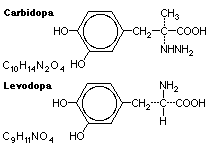
Levodopa is the aromatic amino acid converted in body to dopamine, a neurotransmittor deficient in Parkinson's disease. Controls rigidity and improves movements but less effect on tremor than anti-cholinergic drugs. Chemically itidentified as (-) -3- (3, 4-dihydroxyphenyl)-L-alanine. Levodopa levorotatory stereoisomer of dopa and can be extracted from naturally occuring ground velvet beans and with acetic acid. Levodopa is used to treat symptoms of parkinson's disease. itadministered orally.
Primary Characteristics
Levodopa is also known as L-dopa, Dihydroxyphenyl alanine.
It is of Natural origin and belongs to Phenyl Alanine.
It belongs to Dopamine agonist pharmacological group on the basis of mechanism of action and also classified in Antiparkinson Agents pharmacological group.
Molecular Weight: 197.2 · pKa: 2.3, 8.7,9.7, 13.4 · Solubility in Water: Slightly soluble · Solubility in Alcohol: Insoluble · Non-proprietary name: Levodopa.
Pharmacokinetics
Absorption: Levodopa has an oral bioavailability is 83% (±7%), pre-systemic (first-pass) metabolism accounts for 55% (±5%).
Distribution: Levodopa has a volume of distribution is 1.7l/kg. plasma protein binding is 10-30%.
Elimination: it is metabolised via Hepatic, plasma half-life is 1.3 hr, renal excretion is 80%.
Advertisement
Indications
Levodopa is primarily indicated in conditions like Dopa-responsive dystonia, Parkinsonism, Parkinson's disease, Parkinson's disease (but not drug-induced extrapyramidal symptoms), Restless legs syndrome.
Levodopa is also indicated for secondary conditions like Glucoma.
Contraindications
Levodopa is contraindicated in conditions like Psychosis, Narrow-angle glaucoma, Skin lesions.
Dosage
Levodopa's dosage details are as follows:
| Dose | Single Dose | Frequency | Route | Instructions |
|---|---|---|---|---|
| Adult Dosage | ||||
| 100 mg | 100 mg | Every 8h | PO | Initial, With carbidopa 25 mg, increase gradually as required . |
| 1375 mg | 1375 mg | Every 24h | PO | In div.doses, with carbidopa 75-100 mg, maintenance as required. |
| Paediatric Dosage (20kg) | ||||
| 0 – 0 | — | — | Safety not established | |
| Neonatal Dosage (3kg) | ||||
| No data. | ||||
Drug Interactions
Always consult your physician for the change of dose regimen or an alternative drug of choice that may strictly be required.
Side Effects
Levodopa in overdosage may give rise to further complications which include Hallucinations , Hallucinations , Delirium , Dyskinesias , Mental disturbances , Cardiac irregularities , Bradyphrenia.
Levodopa produces potentially life-threatening effects which include Cardiac arrhythmias, Postural hypotension, Anginal pain, Postural hypotension. Careful monitoring is needed with proper medical management.
The signs and symptoms that are produced after acute overdosage of Levodopa are Hypotension, Nausea, Vomiting, Cardiac arrhythmias, Cytotoxicity, Confusion .
Levodopa is known to cause more or less tolerable side effects which are usually transient. These include Abdominal pain, Anorexia , Constipation , Diarrhea, Discoloration of urine, dizziness, Elevated alkaline phosphatase, Elevated hepatic transaminases, Faintness , GI bleeding, GI upset, Nausea, Palpitation, Vomiting .
Warnings / Precautions
Interference in Pathology
Levodopa may interfere in the diagnosis of Serum tests for bilirubin, catecholamines, creatinine, glucose and uric acid , Urine tests for aminoacids, creatinine, creatinine clearance, oestrogens, glucose & Uric Acid , Urine tests for Ketone, Vanillylmandelic acid, 5-OH Indoleacetic Acid .
Available Brands
Storage Conditions
Drug Classification
- 1.9.1 — Drugs used in parkinsonism