
Ketamine (HCl)
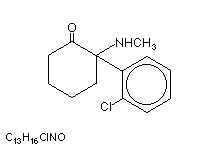
Ketamine (HCl) non barbiturate, sedative hypnotic used parenterally to provide anaesthesia for short diagnostic and surgical procedures. Ketamine (HCl) is arylcyclohexalamine chemically related to phencyclidine (PCP). Ketamine is a fairly short-acting anaesthetic that provides a profound, rapid, dissociative anesthesia and a short recovery time. Ketamine (HCl) is a desirable agent in patients who are hypotensive. Ketamine (HCl) can be used concomitantly with a muscle relaxants without complication because Ketamine (HCl) does not provide muscle relaxation. Ketamine efficacy is offset by the frequent occurrence of dysphoria. Ketamine received FDA approval in 1970. Although the exact mechanism of action is not known, ketamine appears to be an agonist at CNS muscarinic acetylcholine-receptors and opiate-receptors.
Primary Characteristics
It is of Synthetic origin and belongs to Phenyl Cyclohexane.
It belongs to N-methyl d-aspartate antagonist pharmacological group on the basis of mechanism of action. It is also classified under General Anesthetics .
Molecular Weight: 274.2 · pKa: 7.5 · Solubility in Water: 1 in 4 · Solubility in Alcohol: 1 in 14 · Non-proprietary name: Ketamine (HCl).
Pharmacokinetics
Distribution: Ketamine (HCl) has a volume of distribution is ~4 l/kg. plasma protein binding is 20-50 %.
Elimination: it is metabolised via Hepatic (Extensively) CYP3A4, plasma half-life is 10-15min Bphase 2.5hr, renal excretion is 2% (unchanged) 88%(metabolite).
Advertisement
Indications
Ketamine (HCl) is primarily indicated in conditions like General anaesthesia, Induction and maintenance of anaesthesia, Pre-procedure sedation.
Contraindications
Ketamine (HCl) is contraindicated in conditions like Angina, Hypertension, Myocardial infarction, Psychiatric disease, Raised intracranial pressure, Eclampsia, Acne rosacea.
Dosage
Ketamine (HCl)'s dosage details are as follows:
| Dose | Single Dose | Frequency | Route | Instructions |
|---|---|---|---|---|
| Adult Dosage | ||||
| 6.5 – 13 mg/kg | — | Every 24h | IM | For 3-4 min |
| 2 mg/kg | 2 mg/kg | Every 24h | IV | Slowly over 60 sec. |
| 1.25 mg/kg | 1.25 mg/kg | Every 24h | IVInfusion | |
| Paediatric Dosage (20kg) | ||||
| 5 mg/kg | 5 mg/kg | — | Intra Muscular | As Required |
| 1.25 mg/kg | 1.25 mg/kg | — | Intravenous | As required |
| Neonatal Dosage (3kg) | ||||
| No data. | ||||
Drug Interactions
Always consult your physician for the change of dose regimen or an alternative drug of choice that may strictly be required.
Side Effects
Ketamine (HCl) in overdosage may give rise to further complications which include Sinus tachycardia , Hallucinations , Hypotension , Hallucinations , Hypotension , Maculopapular rash , Hypertension , Sinus bradycardia , Respiratory depression , Laryngospasm.
Ketamine (HCl) is known to cause more or less tolerable side effects which are usually transient. These include Anorexia , Apnea , Delirium , Diplopia, Nausea, Nightmares, Nystagmus , Pain at injection site, Psychomimetic reaction, Skin rashes, Vomiting .
Warnings / Precautions
Available Brands
Storage Conditions
Drug Classification
- 1.1.1.1 — Intravenous agents