
Fluocinonide (Topical)
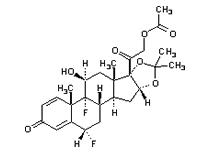
Fluocinonide (Topical) is a topical corticosteroid (class of steroid hormones formed in the adrenal gland ). Fluocinonide (Topical) is used to reduce swelling or inflammation and itching of skin in conditions such as psoriasis, eczema, dermatitis, rashes, insect bites, and allergies etc.
Primary Characteristics
It is of Synthetic origin and belongs to Corticosteroid.
It belongs to Glucocorticoid agonist pharmacological group on the basis of mechanism of action and also classified in Corticosteroid Topical pharmacological group. It is also classified under Dermatological Products .
Molecular Weight: 494.5 · pKa: unionized · Solubility in Water: almost Insoluble · Solubility in Alcohol: 1 in 70 · Non-proprietary name: Fluocinonide (Topical).
Pharmacokinetics
None recorded.
Advertisement
Indications
Fluocinonide (Topical) is primarily indicated in conditions like Dermatitis, Eczema, Flexural psoriasis, Lichen planus, Lichen simplex, Lupus erythematosus, Necrobiosis lipoidica, Pruritus ANI.
Contraindications
Fluocinonide (Topical) is contraindicated in conditions like Bacterial infections, Fungal infection, Viral infection, Ulcers, Acne vulgaris, Rosacea, Perioral dermatitis.
Dosage
Fluocinonide (Topical)'s dosage details are as follows:
| Dose | Single Dose | Frequency | Route | Instructions |
|---|---|---|---|---|
| Adult Dosage | ||||
| 0.05 % | 0.05 % | — | Topical | As Required |
| Paediatric Dosage (20kg) | ||||
| 0.05 % | 0.05 % | — | Topical | As Required |
| Neonatal Dosage (3kg) | ||||
| 0.05 % | 0.05 % | — | Topical | As Required |
Drug Interactions
None recorded.
Side Effects
Fluocinonide (Topical) in overdosage may give rise to further complications which include Glaucoma , Epidermal thinning , Raised intracranial pressure , Striae , Adrenal suppression , Cataract, Growth retardation , Telangiectasia.
Fluocinonide (Topical) is known to cause more or less tolerable side effects which are usually transient. These include Allergic reactions, Perioral dermatitis.
Warnings / Precautions
Interference in Pathology
Fluocinonide (Topical) may interfere in the diagnosis of ACTH Stimulation test, Urinary free cortisol test, ACTH stimulation test.
Available Brands
None recorded.
Storage Conditions
Drug Classification
- 1.13.3.1 — Corticosteroids plain