
Ether
Also known as: Diethyl ether
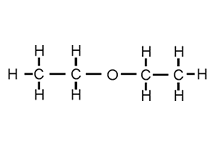
In 1842 Dr cranford long of athens, GA, first used it as a general anesthetic. Ether is an organic compound having an oxygen atom bounded to two carbon atoms. Ether is inhalation anesthetic agent. Inhaled gases are the mainstay of anesthesia and are primarily used for the maintenance of anesthesia after administration of an intravenous agent. The depth of anesthesia can be rapidly altered by changing the concentration of inhaled anesthetic.
Primary Characteristics
Ether is also known as Diethyl ether.
It is of Synthetic origin and belongs to Oxyethane.
It belongs to General Anesthetics-Volatile pharmacological group on the basis of mechanism of action. It is also classified under General Anesthetics .
Molecular Weight: 74.2 · pKa: unionized · Solubility in Water: 1 in 14 · Solubility in Alcohol: miscible · Non-proprietary name: Ether.
Pharmacokinetics
Elimination: it is metabolised via 3.61% via gut, 10% via liver, renal excretion is insignificant.
Advertisement
Indications
Ether is primarily indicated in conditions like Anesthesia, Status asthmaticus.
Ether is also indicated for secondary conditions like Analgesic, Muscle relaxation.
Contraindications
Ether is contraindicated in conditions like Raised intracranial pressure, Pyrexia.
Dosage
Ether's dosage details are as follows:
| Dose | Single Dose | Frequency | Route | Instructions |
|---|---|---|---|---|
| Adult Dosage | ||||
| 4 % | 4 % | — | Inhalation | As Required |
| Paediatric Dosage (20kg) | ||||
| 4 % | 4 % | — | Inhalation | As Required |
| Neonatal Dosage (3kg) | ||||
| 4 % | 4 % | — | Inhalation | As Required |
Drug Interactions
Always consult your physician for the change of dose regimen or an alternative drug of choice that may strictly be required.
Side Effects
Ether in overdosage may give rise to further complications which include Cardiac arrest , PT Time, BGL, Capillary Idecding.
Ether produces potentially life-threatening effects which include Hypersensitivity reactions, Convulsions , ECG abnormalities. Careful monitoring is needed with proper medical management.
The signs and symptoms that are produced after acute overdosage of Ether are Apnea, Cardiotoxicity .
Ether is known to cause more or less tolerable side effects which are usually transient. These include Disturbed renal function, Hepatic degenerative changes , Vomiting .
Warnings / Precautions
Interference in Pathology
Ether may interfere in the diagnosis of Urinary Test of Ethanol , Test for Catecholamines in plasma. .
Available Brands
None recorded.
Storage Conditions
Drug Classification
- 1.1.1.1 — Intravenous agents