
Cortisone (Acetate)
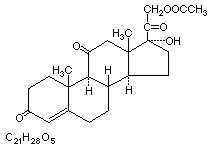
Cortisone (Acetate) is ester of cortisone, which is a natural glucocorticoid with a slight degree of mineralocoricoid activity. Chemically Cortisone (Acetate) is identified as 17, 21-Dihydroxypregn-4-ene-3, 11, 20-trione 21-acetate. It has slow onset but long duration of action. Cortisone (Acetate) is effective as an anti-infalmmatory and immunosuppressant in a wide variety of disorders. Administered orally or intramuscularly.
Primary Characteristics
It is of Synthetic origin and belongs to Steroidal Hormone.
It belongs to Glucocorticoid agonist pharmacological group on the basis of mechanism of action and also classified in Corticosteroid Adrenal pharmacological group.
Molecular Weight: 402.5 · Solubility in Water: 1 in 5000 · Solubility in Alcohol: 1 in 300 · Non-proprietary name: Cortisone (Acetate).
Pharmacokinetics
Absorption: Cortisone (Acetate) has an oral bioavailability is 97% (±2%).
Distribution: Cortisone (Acetate) has a volume of distribution is 0.3 l/kg. plasma protein binding is 95%.
Elimination: it is metabolised via >70% Hepatic, plasma half-life is 1.25 hr, renal excretion is readily.
Advertisement
Indications
Cortisone (Acetate) is primarily indicated in conditions like Adrenocortical insufficiency, Congenital adrenal hyperplasia.
Cortisone (Acetate) is also indicated for secondary conditions like Diarrhoea, Inflammation.
Contraindications
None recorded.
Dosage
Cortisone (Acetate)'s dosage details are as follows:
| Dose | Single Dose | Frequency | Route | Instructions |
|---|---|---|---|---|
| Adult Dosage | ||||
| 25 mg/day | 25 mg/day | Every 24h | PO | in divided doses with fludrocortisone allergic and inflamatory. |
| 25 – 300 mg/day | — | Every 24h | PO/IM | in divided doses with fludrocortisone allergic and inflamatory. |
| Paediatric Dosage (20kg) | ||||
| 0.33 mg/kg | 0.33 mg/kg | Every 8h | Oral | showrly disorders |
| Neonatal Dosage (3kg) | ||||
| No data. | ||||
Drug Interactions
Always consult your physician for the change of dose regimen or an alternative drug of choice that may strictly be required.
Side Effects
Cortisone (Acetate) in overdosage may give rise to further complications which include Skeletal deformation , Fracture , Avascular necrosis of bone , Muscle wasting , Inflammatory response suppression, Glaucoma , Diabetes , Osteoporosis , Depression , Posterior subcapsular cataract , Increased intracranial pressure , Increased IOP (intraocular pressure), Pancreatitis , Hypertension , Psychosis , Immune suppression , Supression of hypothalamic-pituitary-adrenal system.
Cortisone (Acetate) is known to cause more or less tolerable side effects which are usually transient. These include Acne, Body fat deposition, Bruising, Edema, Hirsutism , Moon face, Striae.
Warnings / Precautions
Interference in Pathology
Cortisone (Acetate) may interfere in the diagnosis of React with FeCl3 in measuring serum cholesterol .
Available Brands
None recorded.
Storage Conditions
Drug Classification
- 1.18.1 — Corticosteroids, systemic