
Clonidine (HCl)
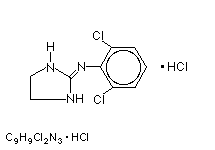
Clonidine (HCl) is 2-imidazoline derivative, is a adrenergic agonist. It was discovered in the course of testing the drugfor use as a topically applied nasal decongestant. and used to treat high blood pressure. It relaxes and dilates blood vessels which results in lowere blood pressure. Clonidine (HCl) is also used to ease withdrawal symptoms associated with the long term use of narcotics or benzodiazipine.
Primary Characteristics
It is of Synthetic origin and belongs to Imidazoline.
It belongs to Alpha-2 adrenergic agonist pharmacological group on the basis of mechanism of action and also classified in Antihypertensive Agents pharmacological group.
Molecular Weight: 266.6 · pKa: 8.05 · Solubility in Water: 1 in 13 · Solubility in Alcohol: 1 in 25 · Non-proprietary name: Clonidine (HCl).
Pharmacokinetics
Absorption: Clonidine (HCl) has an oral bioavailability is 100%, pre-systemic (first-pass) metabolism accounts for 12.5% (±12.5%).
Distribution: Clonidine (HCl) has a volume of distribution is 2 l/kg. plasma protein binding is 20-40%.
Elimination: it is metabolised via 40% hepatic, plasma half-life is 20-25 hr, renal excretion is 60%.
Advertisement
Indications
Clonidine (HCl) is primarily indicated in conditions like Chronic diarrhoea, Diagnosis of pheochromocytoma, Diarrhoea, Glucoma, Hypertension, Menopausal flushing, Migraine prophylaxis, Opiate withdrawal syndrome, Psychiatric disease.
Clonidine (HCl) is also indicated for secondary conditions like Prevention of recurrent migraine, vascular headache, menopausal flushing.
Contraindications
Clonidine (HCl) is contraindicated in conditions like Sinoatrial node disease, Atrioventricular node disease.
Dosage
Clonidine (HCl)'s dosage details are as follows:
| Dose | Single Dose | Frequency | Route | Instructions |
|---|---|---|---|---|
| Adult Dosage | ||||
| 225 ug | 225 ug | — | IV | Slow IV injection over 10-15 minutes. |
| 75 ug | 75 ug | Every 8h | PO | Initial |
| 150 mg | 150 mg | Every 24h | PO | Maintenance |
| 0.1 mg | 0.1 mg | Every 24h | Transdermal | One Transdermal Patch for 7 days |
| Paediatric Dosage (20kg) | ||||
| 6.5 ug/kg | 6.5 ug/kg | Every 24h | Oral | |
| Neonatal Dosage (3kg) | ||||
| No data. | ||||
Drug Interactions
Always consult your physician for the change of dose regimen or an alternative drug of choice that may strictly be required.
Side Effects
Clonidine (HCl) in overdosage may give rise to further complications which include Dilutional hyponatremia , Cardiac arrhythmias, Cardiac arrhythmias , Acute pancreatitis , Bowel pseudo-obstruction , Systemic lupus erythematosus , Acute pancreatitis , Withdrawal syndrome.
The signs and symptoms that are produced after acute overdosage of Clonidine (HCl) are Coma, Ataxia, Miosis, Bradycardia, Cardiac arrhythmias, Hypertension, Dry mouth, Conduction disturbances, Hypothermia, Sedation .
Clonidine (HCl) is known to cause more or less tolerable side effects which are usually transient. These include Abdominal pain, Agitation , Anxiety, Asthenia , Bradycardia , Constipation , Contact dermatitis, Depression, dizziness, Dry mouth, Fatigue, Fluid retention, Hallucination , Impotence, Nausea, Nightmares, Parotid pain, Postural hypotension, Pruritus , Rashes , Sedation , Sleep disturbance, Swelling , Urinary RetentionX, Xerostomia .
Warnings / Precautions
Available Brands
None recorded.
Storage Conditions
Drug Classification
- 1.12.3.6 — Centrally acting sympathoplegic drugs