
Carmustine
Also known as: BCNU
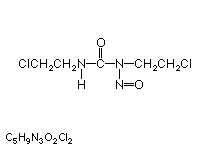
Carmustine is a cytotoxic alkylating agent of the nitrosourea group. Chemically Carmustine is 1,3-bis (2-chloroethyl)-1-nitrosourea (BCNU). All alkylating agent have or can form an alkyl group that becomes covalently bound to cellular constituents. Carmustine is anticancer drug and effective in the treatment of tumors, Hodgkin's disease and certain cancers, used alone or in combination with different anticancer drugs to slow or stop the growth of cancerous or abnormal cells. Administered intravenously.
Primary Characteristics
Carmustine is also known as BCNU.
It is of Synthetic origin and belongs to Nitrosourea.
It belongs to Alkylating Agents pharmacological group on the basis of mechanism of action and also classified in Antineoplastic Agent, Alkylating Agent pharmacological group.
Molecular Weight: 214 · Solubility in Water: 1 in 250 · Solubility in Alcohol: 1 in 2 · Non-proprietary name: Carmustine.
Pharmacokinetics
Distribution: Carmustine has a volume of distribution is 3.3-5.1 l/kg. plasma protein binding is 77%.
Elimination: it is metabolised via significant via liver, plasma half-life is 20-25 min, renal excretion is 60%.
Advertisement
Indications
Carmustine is primarily indicated in conditions like Hodgkin's disease, Malignant brain tumours, Multiple myeloma, Myeloma, lymphoma and brain tumours, Non-hodgkin's lymphoma, Tumours.
Contraindications
Carmustine is contraindicated in conditions like Pre-existing lung disease.
Dosage
Carmustine's dosage details are as follows:
| Dose | Single Dose | Frequency | Route | Instructions |
|---|---|---|---|---|
| Adult Dosage | ||||
| 80 mg/sq.meter | 80 mg/sq.meter | Every 24h | IV Inf | Over 2 Hours for 3 Days |
| Paediatric Dosage (20kg) | ||||
| 0 – 0 | — | — | — | Not Recommended in this Age Group |
| Neonatal Dosage (3kg) | ||||
| 0 – 0 | — | — | — | Not Recommended in this Age Group |
Drug Interactions
Always consult your physician for the change of dose regimen or an alternative drug of choice that may strictly be required.
Side Effects
Carmustine in overdosage may give rise to further complications which include Fatal hepatotoxicity, Focal neurologic deficits , Pulmonary fibrosis .
Carmustine produces potentially life-threatening effects which include Fibrosing alveolitis, Interstitial pneumonitis. Careful monitoring is needed with proper medical management.
The signs and symptoms that are produced after acute overdosage of Carmustine are Myelosuppression , Leucopenia .
Carmustine is known to cause more or less tolerable side effects which are usually transient. These include Local irritation, Nausea, Vomiting .
Warnings / Precautions
Available Brands
None recorded.
Storage Conditions
Drug Classification
- 1.8.2 — Cytotoxic (anti-neoplastic) drugs