
Lamotrigine
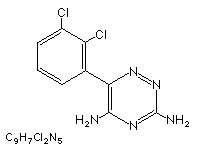
Lamotrigine is a triazine derivarive and chemically Lamotrigine is idetified as 6-(2, 3-dichlorophenyl)-1, 2, 4-triazine-3, 5-diamine, prepared by chemical synthesis. Lamotrigine is oral antiepileptic and anticonvulsant agent developed based on the observation that some antiepileptic drugs possess antifolate activity. Although derived from agents which inhibit dihydrofolate reductase, it has relatively little antifolate activity. It blocks voltage dependent sodium channels. The exact mechanism by which it exhibits its anticonvulsant activity is not known, but studies suggest that it may stabilize neuronal membranes by acting at voltage-sensitive sodium channels. Blocking sodium channels can decrease the presynaptic release of glutamate, an excitatory amino acid, and aspartate resulting in decreased seizure frequency.it can be used alone or as a second-line, additional treatment in patients not staisfactorily controlled on other anticonvulsants.it was originally approved by the FDA December 28, 1994.
Primary Characteristics
It is of Synthetic origin and belongs to Triazine Derivatives.
Molecular Weight: 256.1 · pKa: 5.5 · Solubility in Water: <1 in 1000 · Solubility in Alcohol: 1 in 1000 · Non-proprietary name: Lamotrigine.
Pharmacokinetics
Absorption: Lamotrigine has an oral bioavailability is 49% (±49%).
Distribution: Lamotrigine has a volume of distribution is 0.92-1.22 l/kg. plasma protein binding is 55%.
Elimination: it is metabolised via Hepatic, plasma half-life is 24-35 hr, renal excretion is 10% (unchanged).
Advertisement
Indications
Lamotrigine is primarily indicated in conditions like Adjunctive therapy, Adjunctive therapy with valproate, Adjunctive therapy without valproate, Bipolar disorders, Epilepsy, Epilepsy (monotherapy), Monotherapy (epilepsy), Partial seizures, Seizures, Tonic-clonic seizures.
Lamotrigine is also indicated for secondary conditions like Generalised epilepsy with absence seizures.
Contraindications
Lamotrigine is contraindicated in conditions like Renal failure, Hepatic failure, Hypersensitivity.
Dosage
Lamotrigine's dosage details are as follows:
| Dose | Single Dose | Frequency | Route | Instructions |
|---|---|---|---|---|
| Adult Dosage | ||||
| 25 – 50 mg | — | Every 24h | PO | Initially to a maximum of 100mg every 1 to 2 weeks. |
| 150 mg | 150 mg | — | PO | Maintenance single or in 2 divided doses. |
| Paediatric Dosage (20kg) | ||||
| 300 ug | 300 ug | — | Oral | Initial, repeated on alternate days |
| 600 ug | 600 ug | Every 24h | Oral | Maintenance, As Required |
| Neonatal Dosage (3kg) | ||||
| 3 mg/kg | 3 mg/kg | Every 24h | Oral | Maintenance, As Required |
| 5 mg/kg | 5 mg/kg | — | Oral | Initial, repeated on alternate days |
Drug Interactions
Always consult your physician for the change of dose regimen or an alternative drug of choice that may strictly be required.
Side Effects
Lamotrigine in overdosage may give rise to further complications which include Ataxia , Thrombocytopenia , Aplastic anemia , Aplastic anemia , Stevens johnson syndrome , Epidermal necrolysis , Lymphadenopathy , Lymphadenopathy , Stevens johnson syndrome , Angioedema , Leucopenia, Neutropenia , Nystagmus , Extrapyramidal symptoms, Angioedema , Pancytopenia , Tremors , Epidermal necrolysis , Hepatic failure , Aplastic anemia, Facial edema, Choreoathetosis.
Lamotrigine is known to cause more or less tolerable side effects which are usually transient. These include Aggression, Agitation , Anemia, Anxiety, Arthralgia, Ataxia, Blurred vision, Confusion, Depression, Diplopia, Dizziness, Drowsiness, Fever, Headache, Insomnia, Irritability, Liver dysfunction, Maculopapular rash, Malaise, Nausea, Rashes , Sedation , SomnolenceX, Tremor.
Warnings / Precautions
Available Brands
Storage Conditions
Drug Classification
- 1.5 — Anticonvulsants and Antiepileptics