
Minocycline (HCl)
Minocycline (HCl) is a tetracycline antibiotic with activity against many gram-negative and gram-positive organisms. Minocycline (HCl) is inactive against viruses and fungi. In general, minocycline is the most lipid soluble and is considered the most active of the tetracycline group. Like doxycycline, minocycline is considered a long-acting tetracycline. Because of its lipid solubility, minocycline attains concentrations in the tears and saliva sufficient to eradicate the meningococcal carrier state. Minocycline is equivalent to doxycycline in the treatment of nongonococcal urethritis and mucopurulent cervicitis, but causes fewer adverse effects than doxycycline. Minocycline also has activity against some bacteria that are resistant to other tetracyclines. It has recently been shown to be effective in the treatment of rheumatoid arthritis. Minocycline was approved by the FDA in 1971. Minocycline (HCl) is generally bacteriostatic against most organisms, although high concentrations of tetracyclines may be bactericidal. Bacteriostatic action appears to be a result of reversible binding to ribosomal units of susceptible organisms and inhibition of protein synthesis
Primary Characteristics
It is of Semi Synthetic origin and belongs to Tetracycline.
It belongs to Antibacterial (Proetin synthesis inhibitor) pharmacological group on the basis of mechanism of action and also classified in Antibiotic, Tetracycline Derivative pharmacological group.
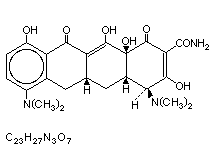
Molecular Weight: 493.9 · pKa: 2.8, 5.0, 7.8, 9.3 · Solubility in Water: sparingaly soluble · Solubility in Alcohol: Slightly soluble · Non-proprietary name: Minocycline (HCl).
Pharmacokinetics
Absorption: Minocycline (HCl) has an oral bioavailability is 100%, pre-systemic (first-pass) metabolism accounts for 3% (±2%).
Distribution: Minocycline (HCl) has a volume of distribution is 78.6 l/kg. plasma protein binding is 75 %.
Elimination: plasma half-life is 11-26 hr, renal excretion is 5-10 %.
Advertisement
Indications
Minocycline (HCl) is primarily indicated in conditions like Acne, Bacterial infections, Cholera, Gonorrhoea, Granulomatous disease, Nocardiosis, Respiratory tract infections, Syphilis.
Minocycline (HCl) is also indicated for secondary conditions like Acne vulgaris, Gastro-oesophageal reflux disease (refractory to other treatment), Meningitis.
Contraindications
Minocycline (HCl) is contraindicated in conditions like Systemic lupus erythematosus.
Dosage
Minocycline (HCl)'s dosage details are as follows:
| Dose | Single Dose | Frequency | Route | Instructions |
|---|---|---|---|---|
| Adult Dosage | ||||
| 200 mg | 200 mg | Every 12h | PO | Maintenance |
| 200 mg | 200 mg | Every 24h | PO | Initial, loading dose. |
| 500 mg | 500 mg | Every 12h | PO | Treatment of acne. |
| Paediatric Dosage (20kg) | ||||
| 2 mg/kg | 2 mg/kg | Every 12h | PO | Maintanace dose |
| 4 mg/kg | 4 mg/kg | — | PO | |
| Neonatal Dosage (3kg) | ||||
| No data. | ||||
Drug Interactions
Always consult your physician for the change of dose regimen or an alternative drug of choice that may strictly be required.
Side Effects
Minocycline (HCl) in overdosage may give rise to further complications which include Stevens johnson syndrome , Stevens johnson syndrome .
Minocycline (HCl) is known to cause more or less tolerable side effects which are usually transient. These include Dizziness, Erythema, Exfoliative dermatitis, Fever, Nausea and vomiting, Photosensitivity, Vertigo, Vestibular dysfunction.
Warnings / Precautions
Interference in Pathology
Minocycline (HCl) may interfere in the diagnosis of Hungarty Methods for Urinary Catecholamines , Urinary Urobilinogen Excretion Methods , Determination of glucose.
Available Brands
Storage Conditions
Drug Classification
- 1.6.2.2.3 — Tetracyclines