
Cocaine
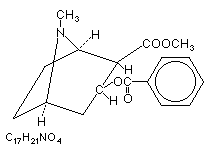
Cocaine is an alkaloid. Chemically Cocaine is benzoylmethylecgonine. Cocaine is a cerebral stimulant and increases the alertness and helps stay awake. It has been used for atleast 1200 years in custom of chewing coca leaves by natives of the South American Andes. It was isolated as the active material in 1844 from Brazikian coca leaves by Gaedken, which for many years was the only source of it. At present the alkaloid is obtained from Java coca leaves. its anesthetic properties, especially its topical anesthetic action were discovered in 1870s and 1880s. its sole clinical use is as a local anesthetic. It readily enters the central nervous system and produces an amphetamine like effects that is short lasting and more intense. Cocaine is a very heavily abused drug because it can be smoked, snorted or injected for rapid onset of effect.
Primary Characteristics
It is of Natural origin and belongs to Tropane.
It belongs to Amine uptake inhibitor pharmacological group on the basis of mechanism of action and also classified in Local Anesthetics pharmacological group. It is also classified under Dermatological Products .
Molecular Weight: 303.4 · pKa: 5.59 · Solubility in Water: 1 in 625 · Solubility in Alcohol: 1 in 6.6 · Non-proprietary name: Cocaine · pH: 4.4 · Isotonic value: 6.33.
Pharmacokinetics
Distribution: Cocaine has a volume of distribution is 84-179 litre. plasma protein binding is 91%.
Elimination: it is metabolised via 90% via liver & serum, plasma half-life is 0.75-1 hr, renal excretion is major.
Advertisement
Indications
Cocaine is primarily indicated in conditions like Cluster headache, Local anaesthesia, Local anaesthetic, Pain, Surface anaesthetic.
Contraindications
Cocaine is contraindicated in conditions like Opthalmologic anaesthesia.
Dosage
Cocaine's dosage details are as follows:
| Dose | Single Dose | Frequency | Route | Instructions |
|---|---|---|---|---|
| Adult Dosage | ||||
| 12.5 % | 12.5 % | — | Topical | As Required |
| Paediatric Dosage (20kg) | ||||
| 0 – 0 | — | — | — | Not Recommended in this Age Group |
| Neonatal Dosage (3kg) | ||||
| 0 – 0 | — | — | Not recommended in this age group | |
Drug Interactions
Always consult your physician for the change of dose regimen or an alternative drug of choice that may strictly be required.
Side Effects
Cocaine in overdosage may give rise to further complications which include Tachycardia , Myocardial ischemia, Paranoia , Muscle twitching , Acute anxiety reactions , High blood pressure , Psychological dependence.
The signs and symptoms that are produced after acute overdosage of Cocaine are Tachycardia , Hypertension, Ventricular arrhythmias, Medullary stimulation, Skin pallor, Clonic seizures.
Cocaine is known to cause more or less tolerable side effects which are usually transient. These include Hallucination , Hyperactivity, Irritability, Lassitude , Paranoid ideation, Repetitive behaviour patterns.
Warnings / Precautions
Interference in Pathology
Cocaine may interfere in the diagnosis of Frings TLC Method of measuring urinary alkaloids .
Available Brands
None recorded.
Storage Conditions
Drug Classification
- 1.1.2 — Local anesthetics