
Ketorolac (Tromethamine)
Also known as: Ketorolac Trometamol
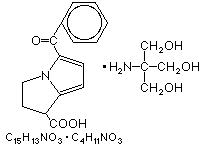
Ketorolac (Tromethamine) is a potent NSAID (non-steroidal anti-inflammatory drug). It inhibits cyclooxygenase actvity with reduction in the tissue production of prostaglandins such as PGE-2 and PGF-2a. Ketorolac (Tromethamine) is prepared by chemical synthesis and racemic mixture is used clinically. Ketorolac (Tromethamine) is ptrrolopyrrole compound with a cyclized propionic acid ring structure. Ketorolac (Tromethamine) is chemically related to tolmetin and zomepirac. It reduces fever and inflammation or swelling and relieves pain. Ketorolac (Tromethamine) is used to treat pain, swelling and stiffness associated with arthritis. Ketorolac (Tromethamine) is also used to treat headaches, muscle aches, dental pain and menstrual cramps.Ketorolac (Tromethamine) is available for oral, parentral and opthalmic administration.
Primary Characteristics
Ketorolac (Tromethamine) is also known as Ketorolac Trometamol.
It is of Synthetic origin and belongs to Pyrolizine carboxy carboxylic acid.
It belongs to Cyclo-oxygenase inhibitor pharmacological group on the basis of mechanism of action. It is also classified under Analgesics and Anti-inflammatory Agents .
Molecular Weight: 376.4 · pKa: 3.54 · Solubility in Water: Freely soluble · Solubility in Alcohol: Slightly soluble · Non-proprietary name: Ketorolac (Tromethamine).
Pharmacokinetics
Absorption: Ketorolac (Tromethamine) has an oral bioavailability is 97% (±2%), pre-systemic (first-pass) metabolism accounts for 5% (±5%).
Distribution: Ketorolac (Tromethamine) has a volume of distribution is 0.11-0.33 l/kg. plasma protein binding is 99.2%.
Elimination: plasma half-life is 4.45-5.6 hr, renal excretion is 90%.
Advertisement
Indications
Ketorolac (Tromethamine) is primarily indicated in conditions like Maintenance in schizophrenia and other psychoses, Moderate to severe pain, Ocular inflammation, Resistant schizophrenia.
Ketorolac (Tromethamine) is also indicated for secondary conditions like Allergic conjunctivitis, Migraine, Short term managment of moderate to severe acute post-operative pain.
Contraindications
Ketorolac (Tromethamine) is contraindicated in conditions like Asthma, Hypertension, Hypovolaemia, Peptic ulcer, Rhinitis, Renal artery stenosis, Dehydration, Hepatic cirrhosis with ascites, Coagulation disorder, Hypersensitivity, Cerebrovascular hemorrhage.
Dosage
Ketorolac (Tromethamine)'s dosage details are as follows:
| Dose | Single Dose | Frequency | Route | Instructions |
|---|---|---|---|---|
| Adult Dosage | ||||
| 22.5 mg | 22.5 mg | Every 6h | IM | |
| 0.5 % | 0.5 % | — | Ophthalmic | As Required.To be given as drops. |
| 25 mg | 25 mg | Every 6h | PO | |
| Paediatric Dosage (20kg) | ||||
| 1 mg/kg | 1 mg/kg | — | 2 to 16 years, To maximum of 30 mg. | |
| Neonatal Dosage (3kg) | ||||
| No data. | ||||
Drug Interactions
Always consult your physician for the change of dose regimen or an alternative drug of choice that may strictly be required.
Side Effects
Ketorolac (Tromethamine) in overdosage may give rise to further complications which include Convulsions , Peptic ulceration , Peptic perforation , Renal impairment , Autoimmune hemolytic anemia.
Ketorolac (Tromethamine) produces potentially life-threatening effects which include GI bleeding, Hypotension, Bronchospasm , Anaphylaxis , Bronchospasm, Laryngeal edema. Careful monitoring is needed with proper medical management.
The signs and symptoms that are produced after acute overdosage of Ketorolac (Tromethamine) are Hypotension, Nausea, Convulsions , Coma, Drowsiness, Blurred vision, Drowsiness, Headache, Epigastric pain, GI bleeding.
Ketorolac (Tromethamine) is known to cause more or less tolerable side effects which are usually transient. These include Abdominal pain, Asthma, Chest pain, Diarrhea, Dizziness, Dry mouth, Dyspepsia , Fluid retention, Headache, Hypersensitivity , Insomnia, Nausea, Pain at injection site, Palpitation, Paresthesias, Rectal bleeding, Somnolence , Sweating , Vomiting .
Warnings / Precautions
Interference in Pathology
Ketorolac (Tromethamine) may interfere in the diagnosis of Abnormal LFTs , Complete blood cell count.
Available Brands
Storage Conditions
Drug Classification
- 1.2.1.3 — Non steroidal anti-inflammatory drugs (NSAIDs)
- 2.21.2.3 — Non steroidal anti-inflammatory drugs (NSAIDs)